
 Recombinant FGF2-G3 (154 aa) protein (Qk053)
 Price range: £175.00 through £2,640.00View product
Price range: £175.00 through £2,640.00
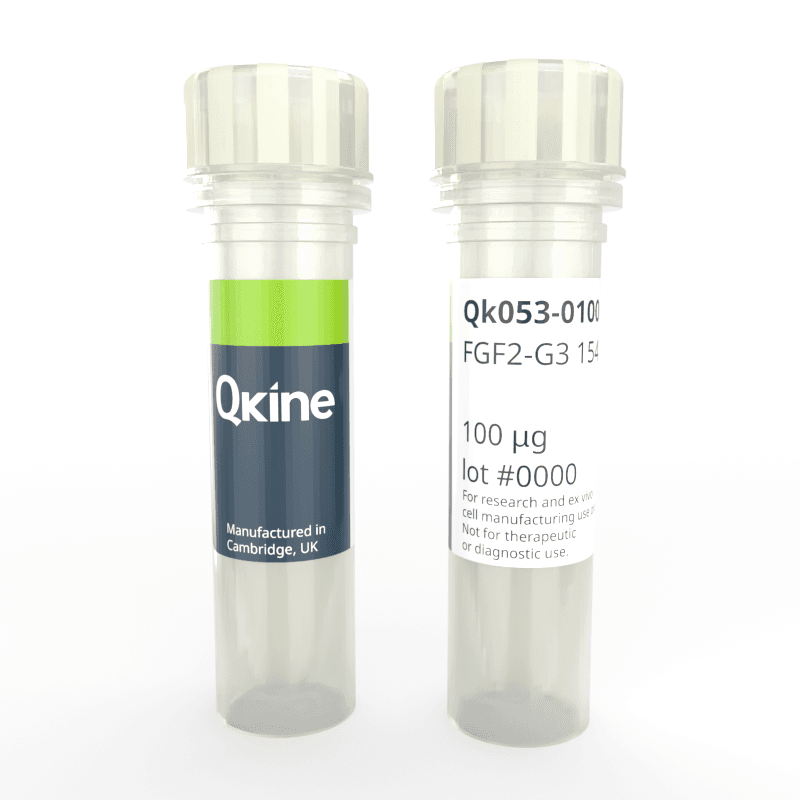
Recombinant FGF2-G3 (FGF2-STAB®) protein is a thermostable engineered form of FGF-2 (bFGF). Qk053 is the 154 aa mature domain of FGF-2 (Qk027) with nine amino acid substitutions to enhance stability without impacting bioactivity developed by Dvorak et al. 2018. This increases the functional half-life of the protein from <10 h (wild-type) to >7 days (FGF2-G3).
Recombinant FGF2-G3 is used in B8 media (Kuo et al. 2019) for weekend free, high homogeneity induced pluripotent stem cell culture. FGF2-G3 also has applications in chemically defined stem cell and organoid culture media, and cultured meat media development.
High purity 17 kDa bioactive FGF2-G3 protein, animal origin-free (AOF), carrier protein-free and tag free.
This protein is also available as GMP compliant Cell Therapy Grade, to enquire email ryan.weber@matriqx.com.
In stock
Orders are typically shipped same or next day (except Friday).
Easy world-wide ordering, direct or through our distributors.
Price range: £175.00 through £2,640.00
Buy online with secure credit card or purchase order. For any questions, please email ryan.weber@matriqx.com
>98%, by SDS-PAGE quantitative densitometry
Animal origin-free (AOF) and carrier protein-free
Expressed in E. coli
Manufactured in our Cambridge, UK laboratories
Lyophilized from Tris, NaCl, CyS, mannitol
Expansion of induced pluripotent, embryonic and mesenchymal stem cells
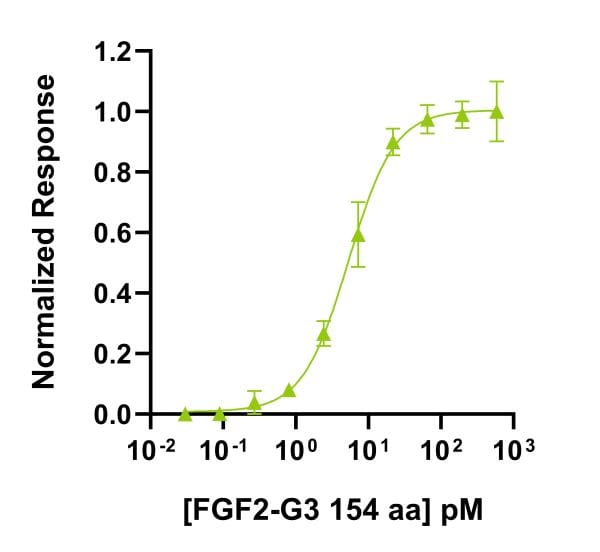
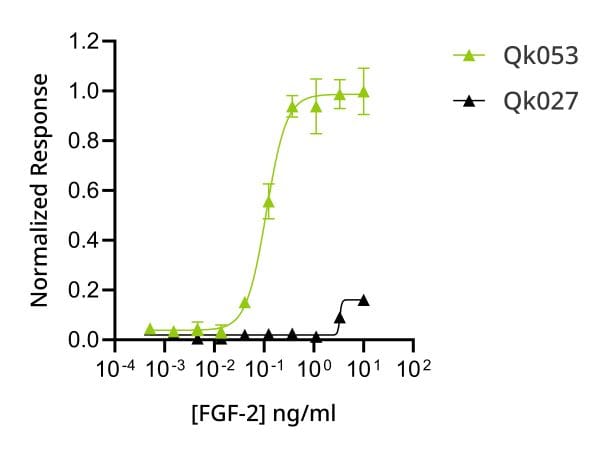
Recombinant FGF2-G3 activity was determined using the Promega serum response element luciferase reporter assay in transfected HEK293T cells. EC50 = 90 pg/ml (5.2 pM). Cells were treated in triplicate with a serial dilution of FGF2-G3 for 3 hours. Firefly luciferase activity was measured and normalized to the control Renilla luciferase activity. Data from Qk053 lot #104340.
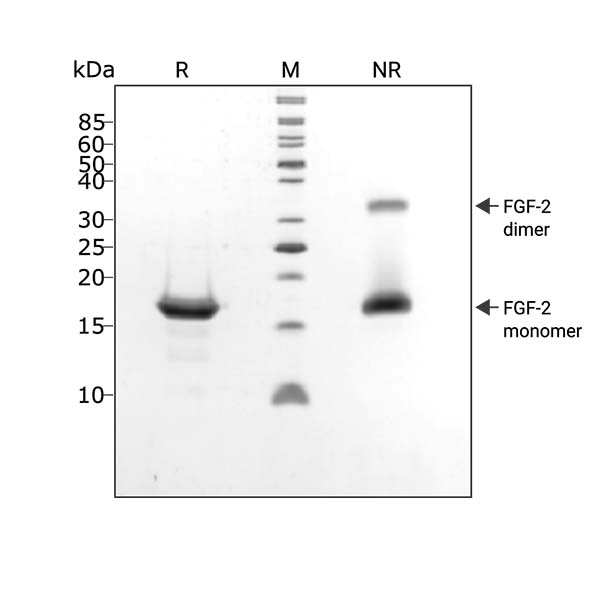
Recombinant FGF2-G3 migrates as a major band at 17 kDa in non-reducing (NR) conditions. The higher molecular weight minor band is the dimeric form. Upon reduction (R), only the 17 kDa band is visible. No contaminating protein bands are present. Purified recombinant protein (3 µg) was resolved using 15% w/v SDS-PAGE in reduced (+β-mercaptothanol, R) and non-reduced (NR) conditions and stained with Coomassie Brilliant Blue R250. Data from Qk053 batch #104340.
Mass spectrometry: single species with expected mass
Recovery from stock vial: >95%
Endotoxin: <0.05 EU/μg protein
We are a company founded and run by scientists to provide a service and support innovation in stem cell biology and regenerative medicine. All our products are exceptionally high purity, with complete characterisation and bioactivity analysis on every lot.
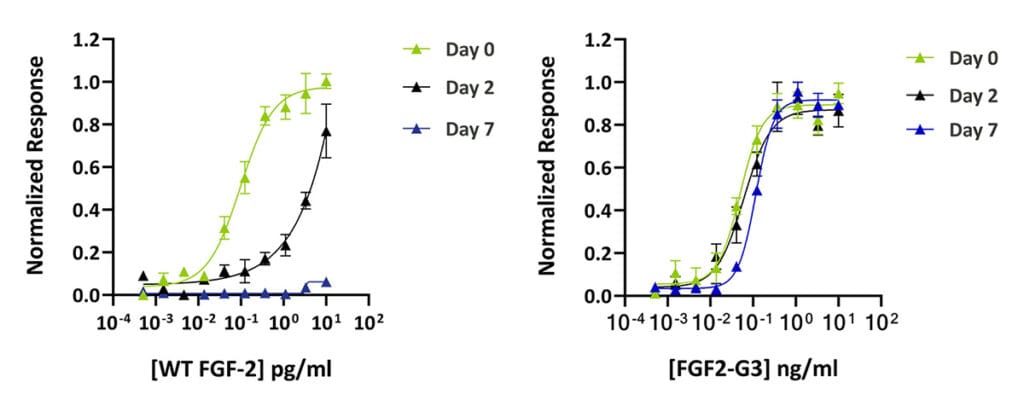
WT FGF-2 (Qk027) and FGF2-G3 (Qk053) were diluted in conditioned media and incubated at 37°C for 2 or 7 days before FGF-2 activity was assayed in triplicate using the Promega serum response element luciferase reporter assay in transfected HEK293T cells. Firefly luciferase activity was normalized to the control Renilla luciferase activity.
FGF-2 (also known as basic FGF or bFGF) is an essential growth factor for maintaining human embryonic stem cell (hESC) and induced pluripotency stem cell (iPSC) pluripotency in feeder-free and chemically defined stem cell media. It is a core component of widely adopted media including mTESR [1, 2], StemPRO [3] and E8 [4]. However, FGF-2 is inherently unstable and prone to proteolytic degradation and aggregation. This fundamental biochemical instability, and therefore low half-life in culture media (<10 h), is an important contribution to the need for frequent media changes and challenges in improving homogeneity during stem cell proliferation and subsequent differentiation.
To improve the stability of FGF-2 for stem cell media and regenerative medicine applications, Dvorak and colleagues at Masaryk University used computer-assisted protein engineering to identify an optimal set of nine amino acid substitutions that stabilize FGF-2. These substitutions were designed to avoid structural changes to the FGF receptor 1 (FGFR1) and FGF receptor 2 (FGFR2) binding sites. This thermostable FGF-2 is known as FGF2-G3, or FGF2-STAB® [5]. The biological activity of wild-type FGF-2 is <50% after 10h incubation with conditioned media. In contrast, no reduction in FGF2-G3 biological activity is observed after >7 days incubation with conditioned media at 37oC. Both FGF2-G3 and wild-type FGF-2 maintain hESC pluripotency and expression of pluripotency markers Oct-4 and nanog with equivalent efficacy [5].
In 2020, Paul Burridge and colleagues at Northwestern University, Chicago, published a protocol for B8 media. This iPSC maintenance media uses thermostable FGF2-G3, along with optimization of media component concentration and composition to reduce media cost and facilitate weekend-free stem cell culture regimes [6, 7].
To manufacture and provide FGF2-G3 for stem cell culture, including use in B8 media and emerging applications such as cultured meat, Qkine has licensed the patented FGF2-G3 technology from Enantis/Masaryk University. We have combined the excellent science behind the FGF2-G3 technology with our protein manufacture expertise to provide gold standard protein for use in cell culture media. We have removed His tags present in academic forms of the protein, as these may give rise to issues for scientists translating discoveries to the clinical or scale-up. His tags also introduce unnecessary scientific uncertainty.
Ong J, Gibbons G, Lim YS et al.
DOI: DOI 10.1088/2752-5724/ae4e4dStavish D, Price CJ, Gelezauskaite G et al.
DOI: https://doi.org/10.1101/2023.09.21.558777van Bree N, Oppelt AS, Lindström S et al.
DOI: doi: 10.1093/neuonc/noae210Boutin L, Liu M, Merville JD et al.
DOI: doi: 10.1080/2162402X.2025.2485535Stavish D, Price CJ, Gelezauskaite G, Alsehli H et al.
DOI: doi: 10.1016/j.stemcr.2024.06.003Beltran-Rendon C, Price CJ, Glen K et al.
DOI: doi: 10.1016/j.jcyt.2024.01.010Iyer DP, Khoei HH, van der Weijden VA et al.
DOI: doi: 10.1016/j.cell.2024.08.048Truszkowski L, Bottini S, Bianchi S et al.
DOI: doi.org/10.12688/openreseurope.18245.2Wang Y, Siebzehnrubl D, Weller M et al.
DOI: doi: 10.1021/acsbiomaterials.5c00068Page T, Musi CA, Bakker SE et al.
DOI: https://doi.org/10.21203/rs.3.rs-5669239/v1Naderlinger E, Murphy C, Feifel E, Jennings P, Gstraunthaler G and Wilmes, A
DOI: doi.org/10.1007/978-1-0716-4530-7_4Becca S, Bianchi S, Hahn EM et al.
DOI: doi.org/10.1101/2025.10.07.680441Skowronska-Krawczyk et al.
DOI: doi.org/10.21203/rs.3.rs-8607320/v1Maeding N, Kundully DS, Steinhuber A et al.
DOI: DOI 10.3389/fimmu.2026.1736994Brochard V, Galle A and Jouneau A
DOI: 10.60675/yrr0-6e39/sn20260212-12r/short-notesFibroblast growth factor 2 (FGF-2), also known as basic fibroblast growth factor (bFGF) is a growth factor and signaling protein.
FGF-2 is expressed in a developmental and tissue specific manner. It’s expression is tightly controlled in normal tissues and it can be detected in all major tissues.
FGF-2 is essential for normal embryonic development. It has roles in cell survival and proliferation, angiogenesis, tumorigenesis, wound healing and tissue repair.
FGF-2 binds to and signals though all four of the FGF receptors FGFR1-4.
FGFRs phosphorylate specific tyrosine residues and activate the RAS-MAPK, PI3K-AKT, PLCγ, and STAT intracellular signaling pathways.
FGF-2 is used to maintain the pluripotency of stem cells in culture.
Recombinant FGF2-G3 (FGF2-STAB®) is a thermostable, engineered form of FGF-2 (bFGF). This modification significantly increases the protein’s functional half-life — from <10 hours for wild-type FGF-2 to >7 days for FGF2-G3 — improving stability and consistency in culture systems.
Our products are for research use only and not for diagnostic or therapeutic use. Products are not for resale.
For use in manufacturing of cellular or gene therapy products. Not intended for in vivo applications.

£100, $140 or €120 Qkine gift card for product reviews with an image and £50, $70 or €60 for reviews without an image.
 Recombinant FGF2-G3 (154 aa) protein (Qk053)