
 Microglial differentiation kit (Qk519)
 Original price was: £2,605.00.£1,705.00Current price is: £1,705.00.
Original price was: £2,605.00.£1,705.00Current price is: £1,705.00.
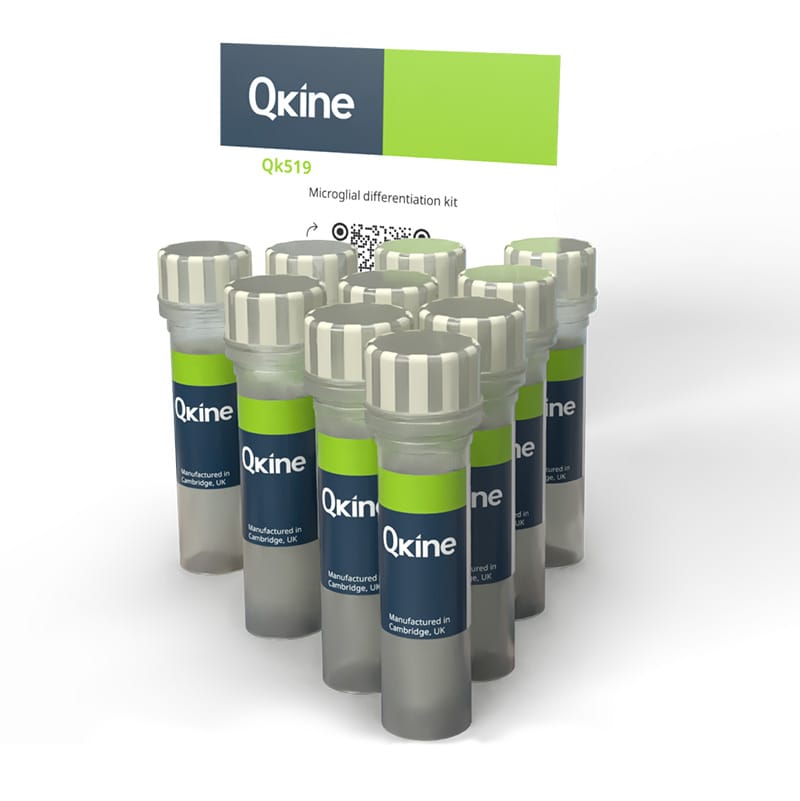
For differentiation of induced pluripotent stem cells (iPSCs) into microglial cells.
Microglia are the primary innate immune cells of the central nervous system (CNS), playing critical roles in brain development, maintenance and repair. Studying human microglia has historically been challenging due to the difficulty of obtaining primary cells from human donors. To overcome this limitation, deriving microglia from induced pluripotent stem cells (iPSCs) has emerged as a promising solution.
The kit includes carefully optimized growth factors required to efficiently guide iPSCs into microglia.
In stock
Orders are typically shipped same or next day (except Friday).
Easy world-wide ordering, direct or through our distributors.
Original price was: £2,605.00.£1,705.00Current price is: £1,705.00.
Buy online with secure credit card or purchase order. For any questions, please email ryan.weber@matriqx.com
>98%, by SDS-PAGE quantitative densitometry
Animal origin-free (AOF) and carrier protein-free
Expressed in E. coli
Bioactivity Guaranteed
Manufactured in our Cambridge, UK laboratories
Lyophilized
Differentiation of induced pluripotent stem cells to microglia

Human BMP-4 – Qk038 – 25 µg
Used for differentiation of mesenchymal cells to adipocytes, epithelial cancer EMT, and regulating neuronal and glial cell development.
FGF2-G3 145 aa – Qk052 – 50 µg
A thermostable engineered form of FGF-2. FGF2-G3 145 aa is the 145 aa active domain of FGF-2 with the functional half-life increased from <10 h (wild-type) to >7 days (FGF2-G3).
Human Flt3L – Qk087 – 25 µg
Stimulates the survival, proliferation, and differentiation of various early myeloid and lymphoid progenitor cells. Flt3L is commonly used in the differentiation of hematopoietic stem cells into dendritic cells.
Human GM-CSF – Qk076 – 25 µg
Commonly used in cell culture to stimulate the differentiation and maturation of human-induced pluripotent stem cells or peripheral blood monocytes to myeloid cells.
Human M-CSF – Qk075 – 25 µg
Used in vitro for the differentiation of human induced pluripotent stem cell (iPSC)-derived macrophages as well as the maintenance and development of monocytes in hematopoietic stem cell culture.
Human IL-3 – Qk090 – 25 µg
Stimulate the differentiation and maturation of human induced pluripotent stem cells towards mast cells, basophils, neutrophils, eosinophils, monocytes, and megakaryocytes.
Human IL-34 PLUS™ – Qk091 – 25 µg
Plays a key role for the development and maintenance of tissue-resident macrophages such as Langerhans cells in the skin and microglia in the brain.
Human SCF – Qk078 – 25 µg
Qkine has optimized the SCF manufacture process to produce a highly bioactive protein with excellent lot-to-lot consistency for enhanced experimental reproducibility.
Human TPO – Qk098 – 25 µg
Thrombopoietin (TPO) is a cytokine which stimulates the production and differentiation of megakaryocytes, regulating platelet production.
Human VEGF – Qk048 – 25 µg
VEGF 165 is commonly used with human-induced pluripotent stem cells or embryonic stem cells-derived endothelial cells for developing human vascular tissue models.
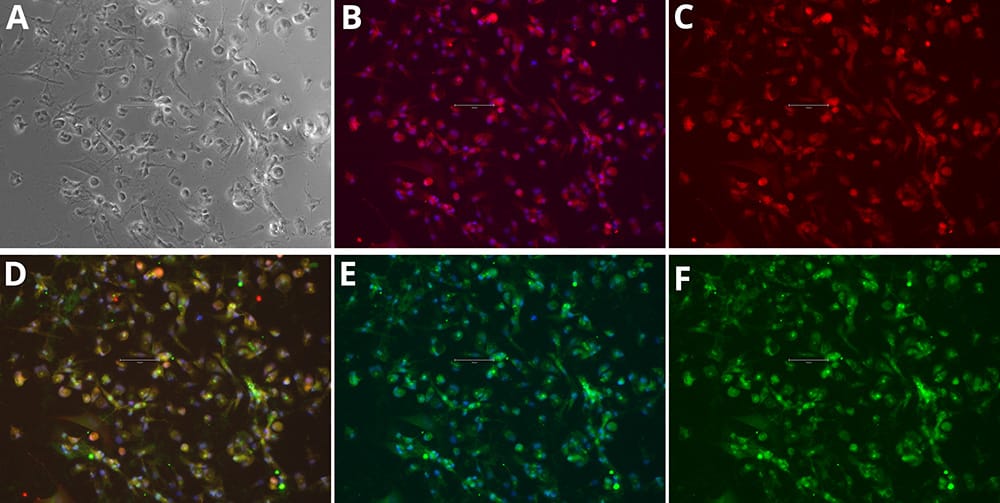
Immunocytochemistry of microglia markers in differentiated iPSCs. Phase Contrast [A], P2RY12 and Hoechst 33258 [B], P2RY12 [Red, C], IBA-1, P2RY12 and Hoechst 33258 [D], IBA-1 and Hoechst 33258 [E], IBA-1 [Green, F]. Images were acquired using the EVOS M5000 system (scale bar = 150 µm). iPSC differentiated using microglial differentiation kit (Qk519).
Application note | Differentiation of induced pluripotent stem cells (iPSCs) into microglia
Mass spectrometry: single species with expected mass
Recovery from stock vial: >95%
Endotoxin: <0.05 EU/μg protein
We are a company founded and run by scientists to provide a service and support innovation in stem cell biology and regenerative medicine. All our products are exceptionally high purity, with complete characterisation and bioactivity analysis on every lot.
Microglia, which originate from mesodermal and mesenchymal lineage, serve as the primary innate immune cells of the central nervous system (CNS) [1]. These cells are highly dynamic and capable of altering their morphology and function in response to various neurological challenges. They play crucial roles in synaptic plasticity, neurogenesis, maintaining homeostasis, and immune defense within the CNS [2] Microglia have also been increasingly recognized for their involvement in neurodegenerative diseases such as Alzheimer’s disease, Parkinson’s disease, and adrenoleukodystrophy (ALD) [3].
Studying human microglia has historically been challenging due to the difficulty of obtaining primary cells from human donors. To overcome this limitation, deriving microglia from induced pluripotent stem cells (iPSCs) has emerged as a promising solution. iPSCs, generated by reprogramming somatic cells into a pluripotent state, can be differentiated into various cell types, including microglia [4]. This approach provides an accessible, scalable, and versatile platform for investigating microglial biology, modeling neurological diseases, and exploring therapeutic applications.
Differentiating iPSCs into microglia involves activating key signaling pathways that mimic the embryonic development of microglia from yolk sac progenitors. The CSF1R signaling pathway, activated by IL-34, is crucial for microglial survival, proliferation, and differentiation. This receptor regulates downstream processes that guide progenitors into the microglial lineage. The TGF-β pathway promotes microglial maturation and the acquisition of functional phenotypes relevant to their roles in the CNS.
Our products are for research use only and not for diagnostic or therapeutic use. Products are not for resale.
For use in manufacturing of cellular or gene therapy products. Not intended for in vivo applications.

£100, $140 or €120 Qkine gift card for product reviews with an image and £50, $70 or €60 for reviews without an image.
 Microglial differentiation kit (Qk519)