
 Recombinant human TGF-β2 protein (Qk072)
 Price range: £320.00 through £3,960.00View product
Price range: £320.00 through £3,960.00
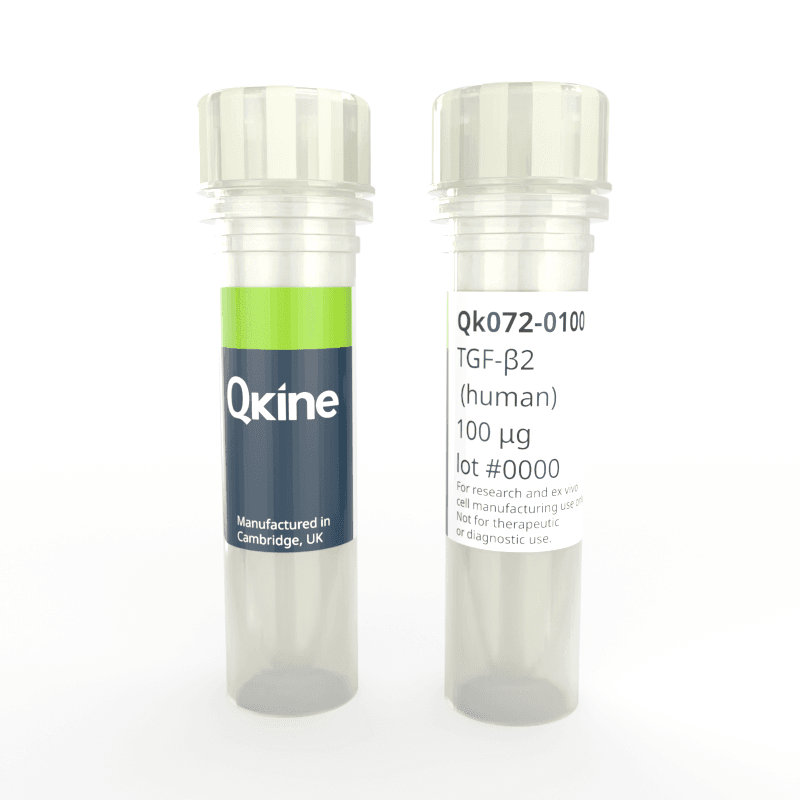

Transforming Growth Factor beta 2 (TGF-β2), part of the TGF-β superfamily, regulates a wide array of cellular processes, including proliferation, differentiation, wound healing, apoptosis, metabolism, embryogenesis, and tissue repair. It is an essential growth factor in many embryonic and induced pluripotent stem cell culture media.
TGF-β2 is a high purity protein with a molecular weight of 25.4 kDa. This protein is carrier-free and tag-free to ensure its purity with exceptional lot-to-lot consistency. Qkine TGF-β2 is suitable for the culture of reproducible and high-quality stem cells and other relevant cells.
This protein is also available as GMP compliant Cell Therapy Grade, to enquire email ryan.weber@matriqx.com.
In stock
Orders are typically shipped same or next day (except Friday).
Easy world-wide ordering, direct or through our distributors.
Price range: £320.00 through £3,960.00
Buy online with secure credit card or purchase order. For any questions, please email ryan.weber@matriqx.com
>98%, by SDS-PAGE quantitative densitometry
Expressed in E. coli
Animal origin-free (AOF) and carrier protein-free
Manufactured in our Cambridge, UK laboratories
Lyophilized from acetonitrile, TFA
Stem cell expansion and maintenance
Epithelial to mesenchymal transition
Stimulation of protein expression and secretion
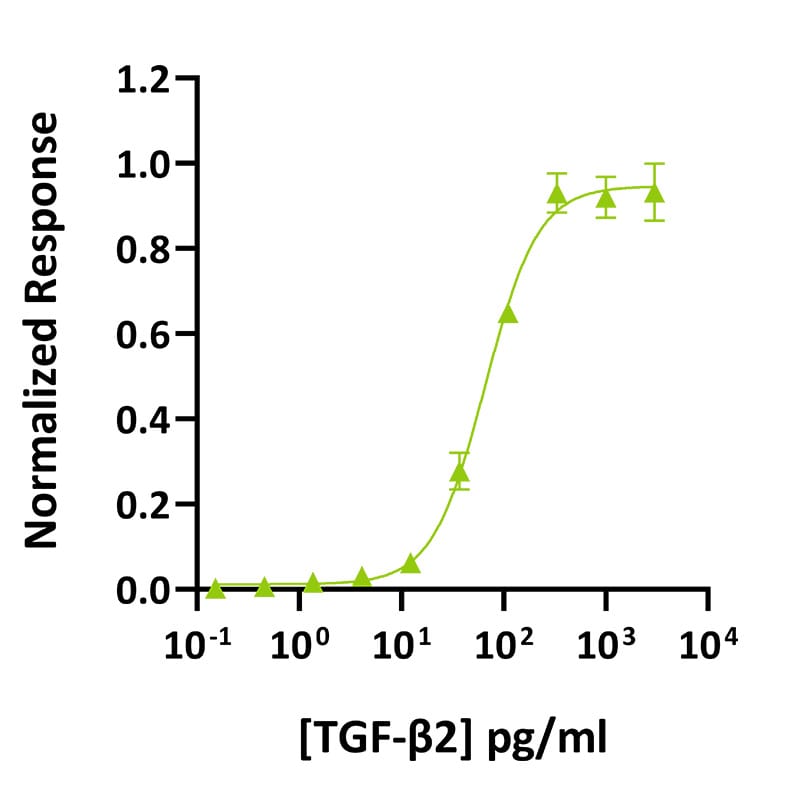
TGF-β2 activity was determined using the TGF-β2-responsive firefly luciferase reporter assay. Transfected HEK293T cells were treated in triplicate with a serial dilution of TGF-β2 for 6 hours. Firefly luciferase activity was measured and normalised to the control Renilla luciferase activity. Data from Qk072 lot #204596. EC50 = 66 pg/ml (2.6 pM)
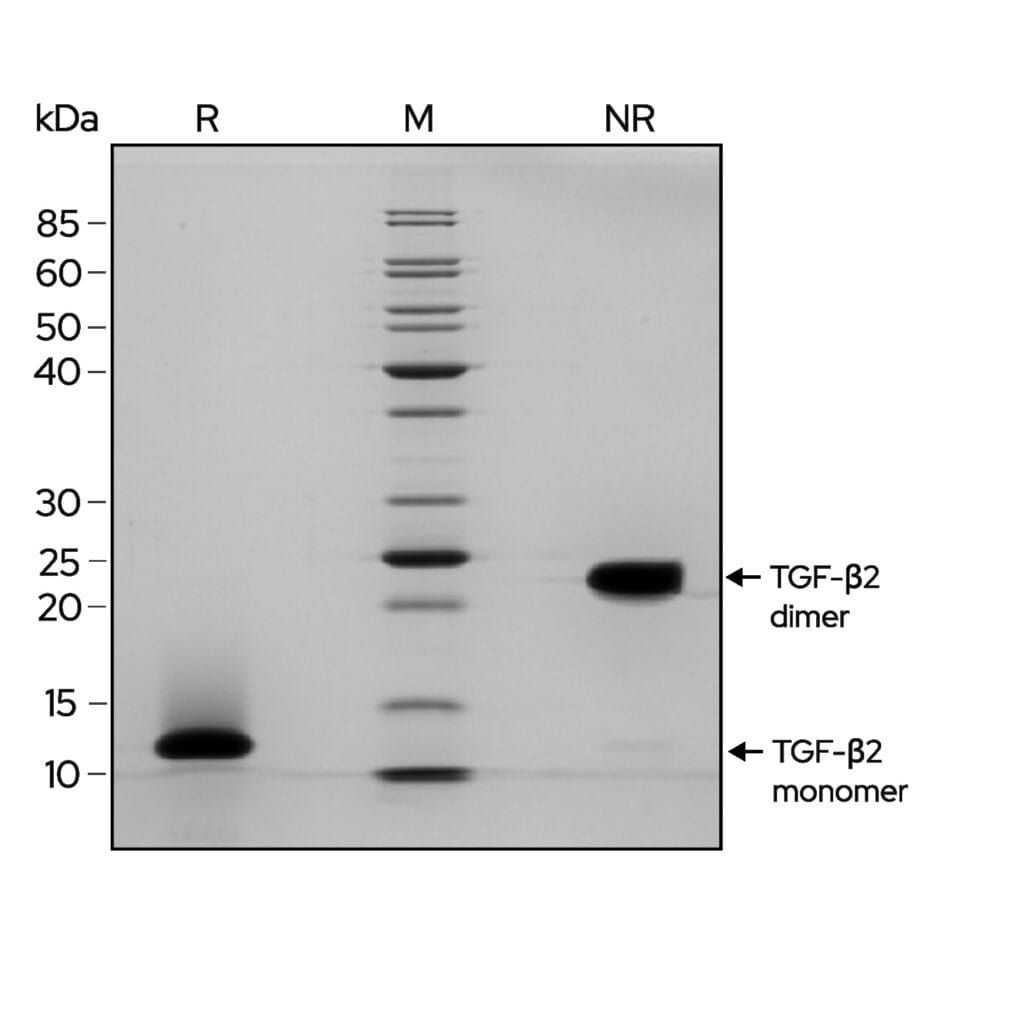
Recombinant TGF-β2 migrates as a major band at approximately 25 kDa (dimer) in non-reducing (NR) conditions. Upon reduction (R), only the monomer band at approximately 12.5 kDa is visible. No contaminating protein bands are present. The purified recombinant protein (3 µg) was resolved using 15% w/v SDS-PAGE in reduced (+β-mercaptoethanol, R) and non-reduced (NR) conditions and stained with Coomassie Brilliant Blue R250. Data from Qk072 lot #204596.
Mass spectrometry: single species with expected mass
Recovery from stock vial: >95%
Endotoxin: <0.05 EU/μg protein
We are a company founded and run by scientists to provide a service and support innovation in stem cell biology and regenerative medicine. All our products are exceptionally high purity, with complete characterisation and bioactivity analysis on every lot.
Transforming Growth Factor beta 2 (TGF-β2) belongs to the TGF-β superfamily, which encompasses TGF-β1, TGF-β2, and TGF-β3. These isoforms collectively regulate a wide array of cellular processes, including cell proliferation, differentiation, wound healing, apoptosis, and metabolism. The TGF-β superfamily signals through the same receptor, eliciting similar biological responses [1- 4].
Overall, the TGF-β family plays pivotal roles in embryogenesis, tissue remodeling, and wound healing. TGF-β2’s significance in developmental processes is evident in mice with TGF-β2 deletions, displaying defects in cardiac, lung, craniofacial, limb, eye, ear, and urogenital systems [5]. It also exerts suppressive effects on IL-2-dependent T-cell growth, potentially enhancing tumour growth by suppressing immunosurveillance [5-6].
In cell culture applications, TGF-beta 2 is extensively employed due to its crucial regulatory roles. It modulates cell proliferation and differentiation by being added to the culture medium, regulating the growth and differentiation of various cell types, especially stem cells, providing a means to control and guide their fate into various cell types such as chondrocytes and epithelial-like cells [7-8]. For wound healing and tissue repair in cell culture models, TGF-beta 2 is utilized to drive cell migration, extracellular matrix production, and overall wound healing processes, creating a controlled environment to mimic conditions associated with tissue repair [3]. TGF-beta 2 is also a key inducer of epithelial-mesenchymal transition (EMT), allowing the study of cellular plasticity and transitions between different cell states [9-10].
TGF-β2’s involvement in immunomodulation, immune response suppression, and its association with tumour development make it valuable in investigating regulatory mechanisms of immune cells and understanding interactions within the tumour microenvironment [9,11]. Additionally, TGF-β2 stimulates the expression and secretion of specific proteins in cell culture, particularly relevant in studies focusing on extracellular matrix components. Researchers may combine TGF-β2 with other growth factors or cytokines to create a more physiologically relevant cellular environment in culture [11].
TGF-β2 is a 25.4 kDa protein composed of two identical 112 amino acid polypeptide chains linked by a single disulfide bond. It forms a latent complex with latency-associated peptide (LAP) and one of the latent TGF-β binding protein (LTBP) family members. This latent complex is stored at the cell surface and in the extracellular matrix. The release of biologically active TGF-β2 involves proteolytic processing of the complex and/or induction of conformational changes by proteins like thrombospondin-1, plasmin, matrix metalloproteases (MMP), or Integrins [12-13].
TGF-β2 signaling involves binding to a complex of the accessory receptor betaglycan (TGF-β RIII) and a type II ser/thr kinase receptor (TGF-β RII) and either TGF-β RI/ALK-5 or ALK-1. This complex activates Smad proteins that regulate transcription, with other Smad-independent pathways contributing to diverse cellular actions [4,14-15]
In summary, TGF-beta 2 plays a crucial role in regulating various cellular processes and is integral to the development of multiple organ systems, exhibiting diverse functions from controlling cell proliferation and differentiation to influencing immune responses and tumorigenesis.
Mulholland KE, Bourguet M, Cheng N et al.
DOI: doi.org/10.1101/2025.04.27.650842TGF beta family proteins and other growth factors can be very poorly soluble in physiological solutions. Please follow the handling guidance for lyophilized cytokines below to minimize loss of protein due to precipitation or adsorption to plastic. We advise storing the recombinant protein at very low pH before dilution in cell culture media or final working solutions. Low pH will also assist in maintaining the correct disulfide structure of the protein by minimizing disulfide bond exchange reactions.
Every effort is made to ensure samples are sterile; however, we recommend sterile filtering after dilution in media or the final working solution.
Our products are for research use only and not for diagnostic or therapeutic use. Products are not for resale.
For use in manufacturing of cellular or gene therapy products. Not intended for in vivo applications.

£100, $140 or €120 Qkine gift card for product reviews with an image and £50, $70 or €60 for reviews without an image.
 Recombinant human TGF-β2 protein (Qk072)