
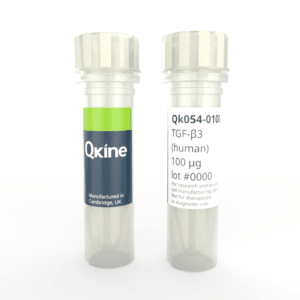
 Recombinant human TGF-β3 protein (Qk054)
 Price range: £320.00 through £3,960.00View product
Price range: £320.00 through £3,960.00

Human transforming growth factor beta 3 (TGF-β3) protein is a member of the TGF-β family, a family involved in regulating cell survival, proliferation and differentiation. TGF-β3 is used in human pluripotent stem cell maintenance media.
Qkine TGF-β3 is a highly pure and bioactive 25.4 kDa protein dimer. Qkine growth factors are animal-origin free (AOF) and carrier-protein free (CF) for reproducible results.
Qkine TGF-β3 is also available as cell therapy grade with extended quality testing and documentation – Qk054-CTG
In stock
Orders are typically shipped same or next day (except Friday).
Easy world-wide ordering, direct or through our distributors.
Price range: £320.00 through £3,960.00
Buy online with secure credit card or purchase order. For any questions, please email ryan.weber@matriqx.com
>98%, by SDS-PAGE quantitative densitometry
Expressed in E. coli
Animal origin-free (AOF) and carrier protein-free
Manufactured in our Cambridge, UK laboratories
Lyophilized from acetonitrile, TFA
Stem cell expansion and maintenance
Induced pluripotent and embryonic stem cell differentiation and maintenance
iPSC-derived mesoderm differentiation
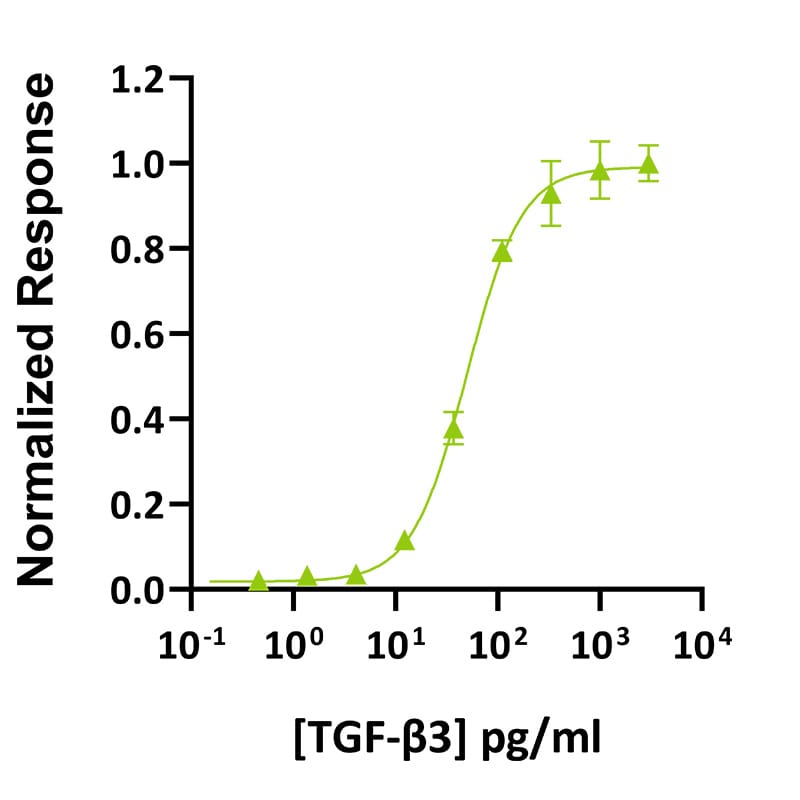
TGF-β3 activity was determined using a TGF-β3 responsive firefly luciferase reporter in HEK293T cells. EC50 = 50 pg/ml. Bioactivity was determined using a TGF-β3 responsive firefly luciferase reporter in HEK293T cells. Cells were treated (in triplicate) with a serial dilution of TGF-β3 for 6 hours. Firefly luciferase activity was measured and normalized to the control Renilla luciferase activity. Data from Qk054 batch #104369.
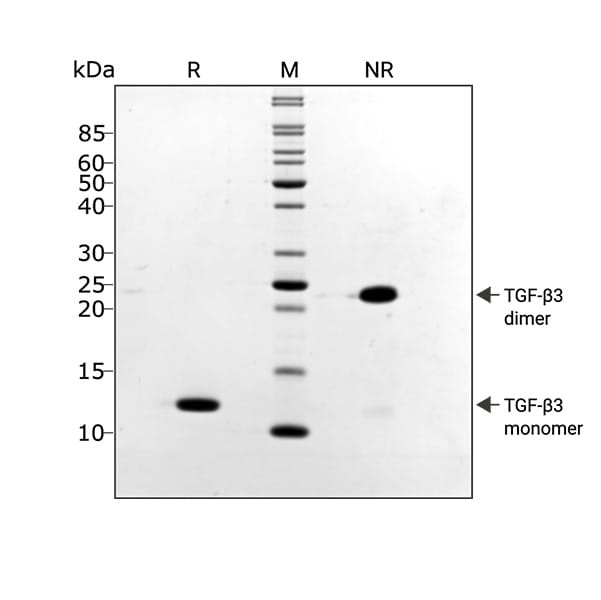
TGF-β3 migrates as a single band at 25 kDa in non-reducing (NR) conditions and 13 kDa upon reduction (R). No contaminating protein bands are visible. Purified recombinant protein (3 µg) was resolved using 15% w/v SDS-PAGE in reduced (+β-mercaptothanol, R) and non-reduced (NR) conditions and stained with Coomassie Brilliant Blue R250. Data from Qk054 batch #104369.
Mass spectrometry: single species with expected mass
Recovery from stock vial: >95%
Endotoxin: <0.05 EU/μg protein
We are a company founded and run by scientists to provide a service and support innovation in stem cell biology and regenerative medicine. All our products are exceptionally high purity, with complete characterisation and bioactivity analysis on every lot.
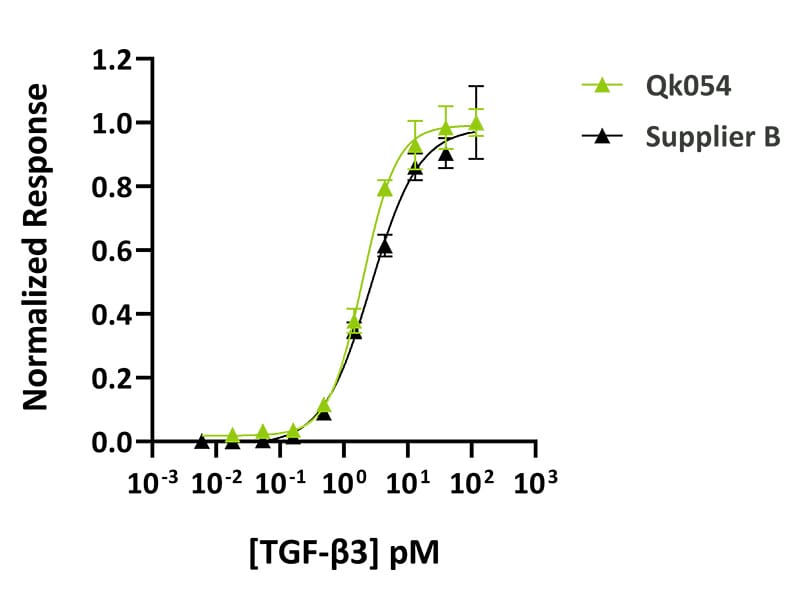
Qkine TGF-β3 (Qk054) bioactivity was compared with an alternative supplier (Supplier B) using a TGF-β3 responsive firefly luciferase reporter in HEK293T cells (as above). Qkine TGF-β3 and Supplier B were found to have equivalent bioactivity, Qk054 EC50 = 50 pg/ml, Supplier B EC50 = 67 pg/ml (no significant difference).
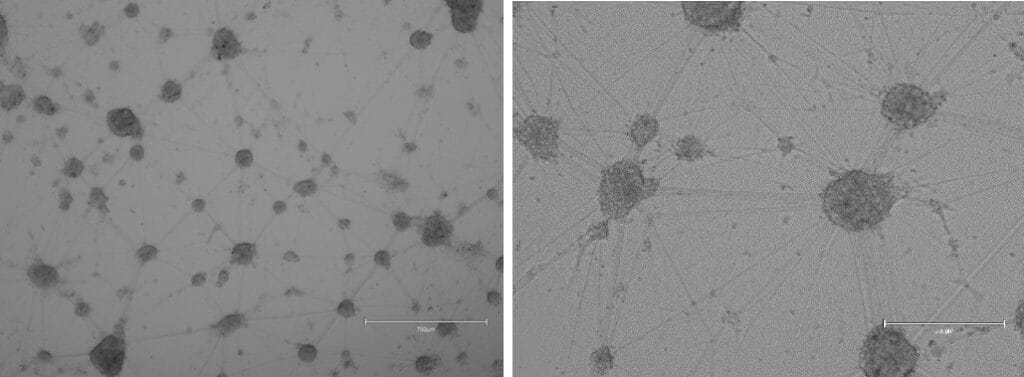
Differentiation of induced pluripotent stem cells (iPSCs) into dopaminergic neurons
Qkine animal origin-free growth factors BDNF (Qk050), FGF-8a (Qk059), GDNF (Qk051) and TGF-β3 (Qk054) can supported the differentiation of iPSCs into mature dopaminergic neurons within 35 days.
Day 35 differentiated mature dopaminergic neurons (A, scale bar = 750 µM, B, scale bar = 300 µM).
Transforming growth factor beta 3 (TGF-β3) is a member of the TGF-β family (and TGF-β superfamily). Like other TGF-β family members – TGF-β1 and 2 – TGF-β3 signals via receptor complexes consisting of Type I and Type II serine/threonine kinase receptors, activating intracellular SMAD transcription factors [1]. The TGF-β family have a high degree of overlap/redundancy and regulate a variety of cellular functions, including cell survival, proliferation, and differentiation [2]. TGF-β3 has isoform-specific roles in embryonic palate fusion [3] and wound healing [4].
In culture, TGF-β3 is often used in human pluripotent cell maintenance. TGF-β3 is a component of B8 media – the low-cost weekend-free iPSC media developed in the lab of Paul Burridge, Northwestern University [5]. In the development of B8 media, Kuo et al. proved that while TGF-β1 can maintain iPSCs at 2 ng/ml, TGF-β3 can maintain iPSCs in as little as 0.1 ng/ml, making it a cost-effective alternative to TGF-β1 [5].
Lyra-Leite DM, Copley RR, Freeman PP et al.
DOI: doi: 10.1016/j.stemcr.2023.05.004Truszkowski L, Bottini S, Bianchi S et al.
DOI: doi.org/10.12688/openreseurope.18245.2Shin D, Kim CN, Ross J et al.
DOI: doi: 10.1016/j.stem.2024.01.010Bottini S (Thesis)
DOI: ThesisTGF-β3 is a growth factor involved in tissue development, wound healing, and immune regulation, crucial for iPSC and ESC proliferation and differentiation.
TGF-β3 is found in various tissues throughout the body, including the skin, bones, blood vessels, and immune cells.
Yes, TGF-β3 is a cytokine.
The TGF-β3 gene encodes the transforming growth factor beta 3 protein.
TGF-β3 binds to TGF-β receptors. This triggers intracellular signaling pathways that regulate gene expression, influencing cellular processes.
The TGF-β3 receptor serves as a cell surface receptor for the TGF-β3 ligand. It plays a crucial role in transmitting signals from the extracellular environment to the interior of the cell upon ligand binding and initiating intracellular signaling cascades that regulate gene expression.
The TGF-β3 pathway is a series of intracellular signaling events triggered by the binding of TGF-β3 ligands to their cell surface receptors. Upon ligand binding, the TGF-β3 receptors undergo phosphorylation and activation, leading to the activation of downstream signaling molecules such as Smad proteins. These Smad proteins translocate into the nucleus, where they regulate the expression of target genes involved in various cellular processes such as proliferation and differentiation.
TGF-β3 regulates cell behavior, promoting differentiation and wound healing. It is often used in tissue engineering, cellular agriculture industries for cultivated meat, and immune modulation.
TGF beta family proteins and other growth factors can be very poorly soluble in physiological solutions. Please follow the handling guidance for lyophilized cytokines below to minimize loss of protein due to precipitation or adsorption to plastic. We advise storing the recombinant protein at very low pH before dilution in cell culture media or final working solutions. Low pH will also assist in maintaining the correct disulfide structure of the protein by minimizing disulfide bond exchange reactions.
Every effort is made to ensure samples are sterile; however, we recommend sterile filtering after dilution in media or the final working solution.
Our products are for research use only and not for diagnostic or therapeutic use. Products are not for resale.
For use in manufacturing of cellular or gene therapy products. Not intended for in vivo applications.

£100, $140 or €120 Qkine gift card for product reviews with an image and £50, $70 or €60 for reviews without an image.
 Recombinant human TGF-β3 protein (Qk054)