
 Tri-lineage differentiation kit (Qk516)
 Original price was: £1,045.00.£705.00Current price is: £705.00.
Original price was: £1,045.00.£705.00Current price is: £705.00.

For validating the ability of new or established induced pluripotent stem cell (iPSC) lines to differentiate to the three germ layers: ectoderm, mesoderm, and endoderm.
The tri-lineage differentiation kit is designed to validate the differentiation potential of both newly derived and established iPSC lines. This kit enables the evaluation of the ability of iPSCs to differentiate into the three primary germ layers: ectoderm, mesoderm, and endoderm.
The kit includes carefully optimized growth factors required to efficiently guide iPSCs toward one of the three germ lineages. It serves as both an endpoint assay—confirming pluripotency and lineage commitment—and a platform for generating lineage-specific progenitor cells for further downstream applications.
Each kit is sufficient for differentiation of 3x 96 well plates per differentiation, 9x 96 wells total.
In stock
Orders are typically shipped same or next day (except Friday).
Easy world-wide ordering, direct or through our distributors.
Original price was: £1,045.00.£705.00Current price is: £705.00.
Buy online with secure credit card or purchase order. For any questions, please email ryan.weber@matriqx.com
>98%, by SDS-PAGE quantitative densitometry
Animal origin-free (AOF) and carrier protein-free
Expressed in E. coli
Bioactivity Guaranteed
Manufactured in our Cambridge, UK laboratories
Lyophilized
Differentiation of iPSC into endoderm, mesoderm and ectoderm

Human activin A – Qk001 – 25 µg
Frequently used to maintain pluripotency in induced pluripotent and embryonic stem cell cultures. It is also used in many stem cell differentiation protocols, including endoderm lineage differentiation and further maturation into hepatocyte and pancreatic cells.
Human BMP-4 – Qk038 – 25 µg
A key regulator of embryogenesis and supports the differentiation of embryonic stem cells and induced pluripotent stem cells.
Human FGF2-G3 (154 aa) – Qk053 – 50 µg
A thermostable engineered form of human FGF-2. Human FGF2-G3 154 aa is the 154 aa mature domain of FGF-2. The functional half-life has increased from <10 h (wild-type) to >7 days (FGF2-G3).
Human noggin – Qk034 – 25 µg
Noggin is used in the culture of intestinal, pancreatic, lung and tumor-derived organoids and the maintenance of undifferentiated embryonic stem cells (ESC) and for stem cell differentiation into neural and microglial lineages.
Human vitronectin – Qk120 – 500 µg
Provides a defined environment that supports the maintenance of pluripotency and is suitable for feeder-free culture, expansion, differentiation, and reprogramming of stem cells.
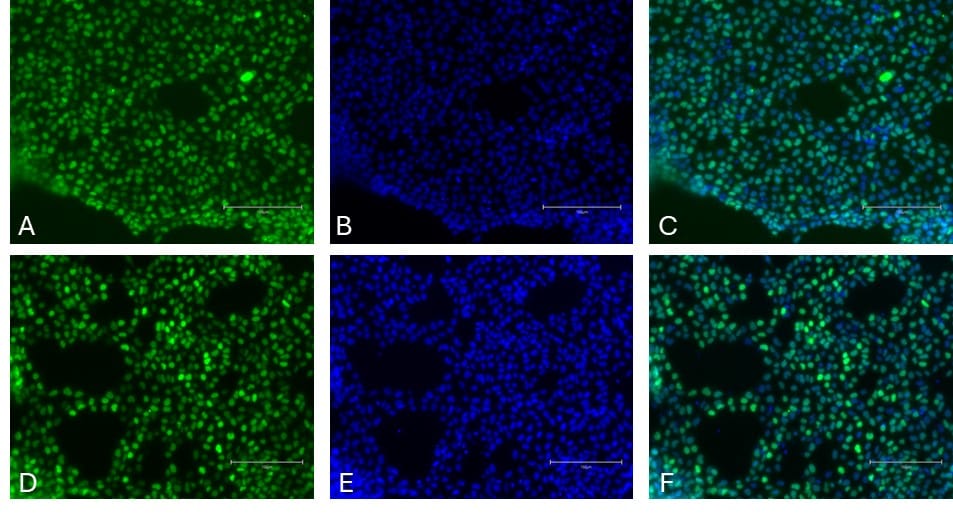
Immunocytochemistry of endoderm markers in differentiated iPSC. SRY-box transcription factor 17 (SOX17) [Green, A], Hoechst 33258 [Blue, B], combined SOX17 and Hoechst [C] and transcription factor GATA4 [Green, D], Hoechst 33258 [Blue, E], combined GATA4 and Hoechst [F]. Images were acquired using the tile functionality of the Zeiss LSM 980 with Airyscan2 at 10x magnification.
Application note | Differentiation of induced pluripotent stem cells (iPSCs) into endoderm

Mass spectrometry: single species with expected mass
Recovery from stock vial: >95%
Endotoxin: <0.05 EU/μg protein
We are a company founded and run by scientists to provide a service and support innovation in stem cell biology and regenerative medicine. All our products are exceptionally high purity, with complete characterisation and bioactivity analysis on every lot.
Immunocytochemistry of Mesoderm markers in differentiated iPSCs. Transcription factor Brachyury [Green, A], Hoechst 33258 [Blue, B], combined Brachyury and Hoechst [C] and transcription factor MIXL1 [Green, D], Hoechst33258 [Blue, E], combined MIXL1 and Hoechst [F]. Images were acquired using the EVOS M5000 (scale bar = 150 µm).
Application note | Differentiation of induced pluripotent stem cells (iPSCs) into mesoderm
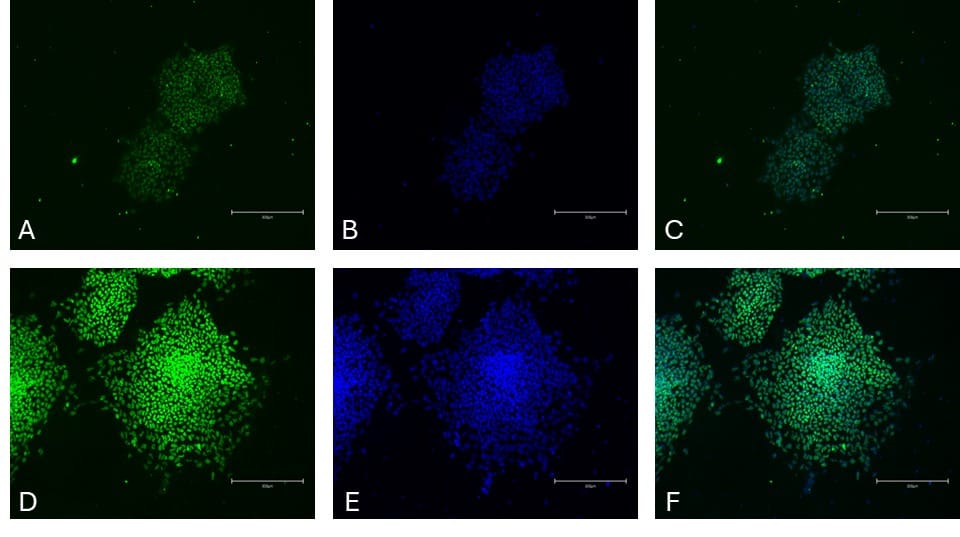
Immunocytochemistry of neuroectoderm markers in differentiated iPSCs. SRY-box transcription factor 1 (SOX1) [Green, A], Hoechst 33258 [Blue, B], combined SOX1 and Hoechst [C] and SRY-box transcription factor 2 (SOX2) [Green, D], Hoechst33258 [Blue, E], combined SOX2 and Hoechst [F]. Images were acquired using the EVOS M5000 system (scale bar = 300 µm).
Application note | Differentiation of induced pluripotent stem cells (iPSCs) into neuroectoderm
Human induced pluripotent stem cells (iPSCs) are an in vitro model that represent a pivotal breakthrough in regenerative medicine and cellular biology. iPSCs are generated by reprogramming adult somatic cells to a pluripotent state through the introduction of specific transcription factors. Reprogramming iPSCs grants these cells the ability to differentiate into any cell type of the three germ layers: ectoderm, mesoderm, and endoderm. This provides unparalleled potential for disease modeling, drug discovery, and cell-based therapies, all without the ethical concerns associated with using embryonic stem cells [1].
Fischer Y, Mosher J, Barbaric I et al.
DOI: doi.org/10.1016/j.stemcr.2025.102780Our products are for research use only and not for diagnostic or therapeutic use. Products are not for resale.
For use in manufacturing of cellular or gene therapy products. Not intended for in vivo applications.

£100, $140 or €120 Qkine gift card for product reviews with an image and £50, $70 or €60 for reviews without an image.
 Tri-lineage differentiation kit (Qk516)