
 Recombinant human IL-2 protein (Qk089)
 Price range: £150.00 through £735.00View product
Price range: £150.00 through £735.00
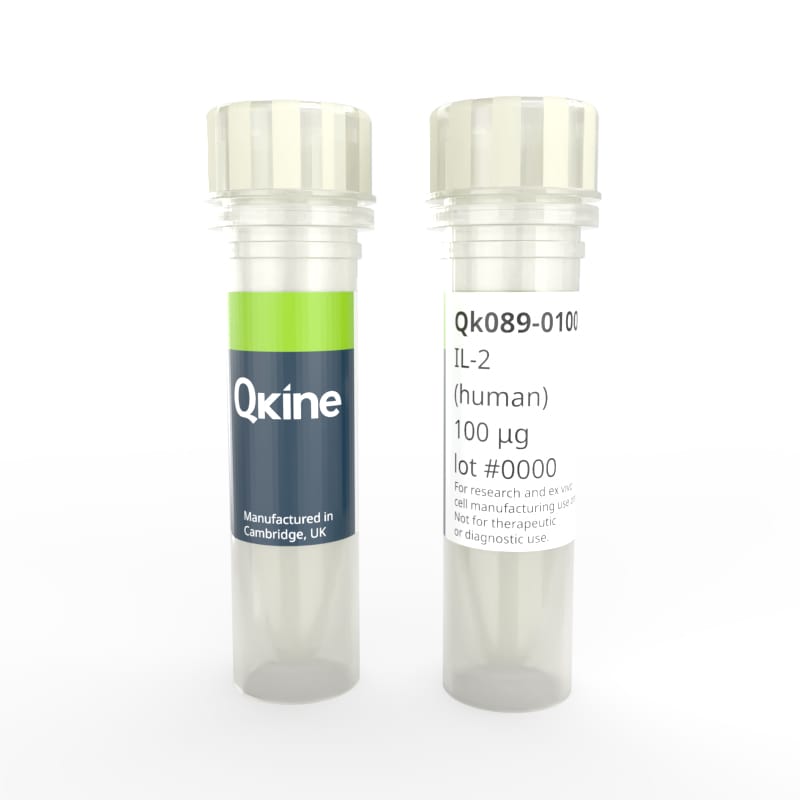

Interleukin-2 (IL-2) is a vital cytokine that regulates immune responses by promoting the growth and activation of T-cells, enhancing immune function, and maintaining immune tolerance for immune activation and suppression.
Qkine has optimized the IL-2 manufacture process to produce a highly bioactive protein with excellent lot-to-lot consistency for enhanced experimental reproducibility. Qkine IL-2 is a highly pure 15.5 kDa monomer, animal origin-free (AOF) and carrier-protein-free (CF).
Qkine IL-2 is also available as cell therapy grade with extended quality testing and documentation – Qk089-CTG
In stock
Orders are typically shipped same or next day (except Friday).
Easy world-wide ordering, direct or through our distributors.
Price range: £150.00 through £735.00
Buy online with secure credit card or purchase order. For any questions, please email ryan.weber@matriqx.com
>98%, by SDS-PAGE quantitative densitometry
Expressed in E. coli
Animal origin-free (AOF) and carrier protein-free
Manufactured in our Cambridge, UK laboratories
Lyophilized from acetonitrile, TFA
Activation of T-cells and natural killer (NK) cells
Differentiation of T-cells
Development and maintenance of regulatory T-cells (Tregs)
Promotion of the expansion of effector T-cells
Recombinant IL-2 activity was determined using a SRE luciferase reporter assay in transiently transfected HEK293 cells co-transfected with the IL-2 receptors (IL-2Rβ and IL-2Rγ). Transfected cells were treated in triplicate with a serial dilution of IL-2 for 3 hours. Firefly activity was measured and normalized to the control Renilla luciferase activity. Data from Qk089 lot #204686. EC50 = 0.86 ng/ml (55 pM).
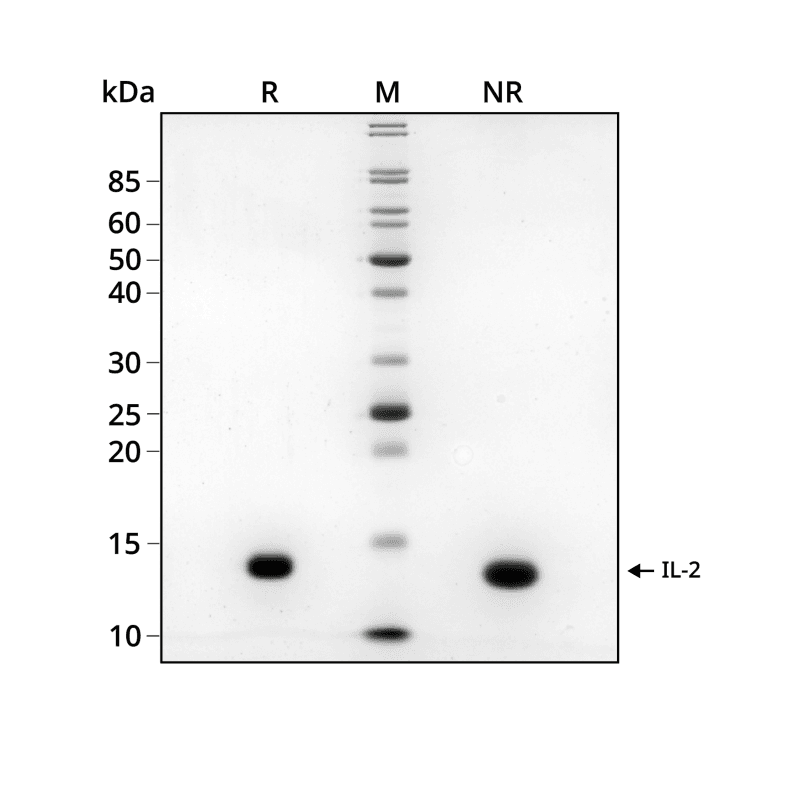
Recombinant IL-2 migrates at approximately 15.5 kDa (monomer) in reduced (R) and non-reduced (NR) conditions. No contaminating protein bands are present. The purified recombinant protein (3 µg) was resolved using 15% w/v SDS-PAGE in reduced (+β-mercaptoethanol, R) and non-reduced (NR) conditions and stained with Coomassie Brilliant Blue R250. Data from Qk089 lot #204686.
Mass spectrometry: single species with expected mass
Recovery from stock vial: >95%
Endotoxin: <0.05 EU/μg protein
We are a company founded and run by scientists to provide a service and support innovation in stem cell biology and regenerative medicine. All our products are exceptionally high purity, with complete characterisation and bioactivity analysis on every lot.
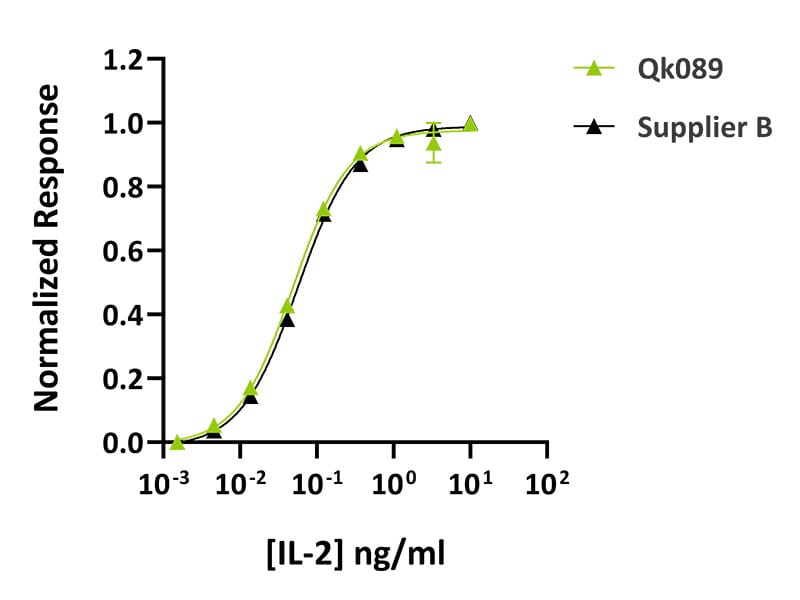
Qkine IL-2 is as biologically active as the comparable alternative supplier protein. IL-2 bioactivity was determined using the Promega IL-2 bioassay kit. Cells were stimulated with Qkine IL-2 (Qk089, green) and alternative supplier IL-2 (Supplier B, black). Cells were treated in triplicate with a serial dilution of IL-2 for 6 hours. Data from Qk089 lot #204686.
Interleukin-2 (IL-2/IL2) is a cytokine that plays a vital role in the immune system, particularly in T-cell development, growth, and activity. IL-2 is produced mainly by activated CD4+ T-cells in response to antigenic stimulation and is essential for both immune response amplification and immune regulation [1,2].
IL-2 is a single-chain glycoprotein composed of 133 amino acids with a molecular weight of 15.5 kDa. The IL-2 receptor (IL-2R) is a complex made up of three subunits: IL-2Rα (CD25), IL-2Rβ (CD122), and the common gamma chain (γc, CD132). When IL-2 binds to its receptor, it activates downstream signaling pathways like JAK-STAT and PI3K-AKT, promoting cell survival, proliferation, and differentiation [3].
IL-2 is critical for the expansion of effector T-cells, which are responsible for attacking and eliminating pathogens and cancer cells. It also plays a role in the development and maintenance of regulatory T-cells (Tregs), which prevent autoimmune responses by keeping the immune system in check. IL-2 enhances the activity of natural killer (NK) cells and B-cells, contributing to overall immune defense [4].
IL-2 is used in cancer immunotherapy, particularly for treating metastatic melanoma and renal cell carcinoma, where it boosts the immune system’s ability to attack tumors. Low-dose IL-2 is being investigated for autoimmune diseases such as lupus and type 1 diabetes, where it can promote Treg expansion to restore immune balance. IL-2 has also been explored as a treatment for chronic infections like HIV and hepatitis C by enhancing immune cell recovery and function. Its role as an adjuvant in vaccines and its potential in organ transplantation to promote immune tolerance are also being actively studied [5].
IL-2 is a cytokine that regulates immune responses by promoting the growth and activation of T-cells, enhancing immune function, and maintaining immune tolerance for immune activation and suppression.
IL-2 is found in the immune system, produced by activated CD4+ T-cells, CD8+ T-cells, and natural killer cells, primarily within lymphoid tissues like lymph nodes and the spleen.
Yes, IL-2 is a cytokine. Cytokines are small proteins that help regulate the immune system, and IL-2 specifically plays a key role in the activation, growth, and proliferation of T-cells and other immune cells.
The IL-2 gene encodes interleukin-2, a cytokine crucial for T-cell proliferation, activation, and survival, playing a key role in immune response and regulation.
IL-2 primarily binds to the IL-2 receptor (IL-2R), which has three subunits: alpha (CD25), beta (CD122), and gamma (CD132). This binding initiates signaling pathways such as JAK-STAT, MAPK and PI3K-AKT pathways that promote T-cell growth, differentiation, and survival.
The IL-2 receptor (IL-2R) mediates interleukin-2 signaling, promoting T-cell proliferation, activation, and survival. It regulates immune responses, maintains immune homeostasis, and stimulates other immune cells, contributing to a balanced and effective adaptive immune response.
The IL-2 pathway involves IL-2 binding to its receptor, activating JAK kinases, which phosphorylate STAT proteins. This triggers gene expression for T-cell proliferation and survival, while also activating MAPK and PI3K-AKT pathways, enhancing overall immune response and regulation.
IL-2 is utilized in cell culture to promote T-cell growth and proliferation, maintaining cell viability by preventing apoptosis. It aids in differentiating T-cell subsets, supports functional assays for cytokine production, and is used in co-culture systems with other immune cells to study immune interactions and responses effectively.
Our products are for research use only and not for diagnostic or therapeutic use. Products are not for resale.
For use in manufacturing of cellular or gene therapy products. Not intended for in vivo applications.

£100, $140 or €120 Qkine gift card for product reviews with an image and £50, $70 or €60 for reviews without an image.
 Recombinant human IL-2 protein (Qk089)