
Qkine proteins are stable and bioactive after 14 days at room temperature and multiple freeze-thaws
Kane Phillips and Kerry Price, Qkine
Qkine manufactures high-purity, animal origin-free growth factors, cytokines and other complex proteins for life science applications including stem cell and organoid culture. Qkine is committed to sustainability in science and as part of this commitment we ship our proteins lyophilized and at ambient temperature. With shipping around the world becoming more complex, we’ve performed a series of tests to reassure our customers of the stability of our growth factors over an extended period.
To assess stability, selected lyophilized proteins; TGF-β1 PLUSTM (Qk010), FGF-2 145 aa (Qk025), Flt3L (Qk087) and IL-2 (Qk089) were stored at room temperature or subjected to 4 freeze-thaw cycles, alternating between room temperature and -80 °C for 14 days before bioactivity and protein degradation were assessed. These proteins were chosen to be representative of the Qkine catalog, covering different growth factor families and being lyophilized from different buffers.
This mimicked the potential time spent outside of cold storage and possible fluctuating temperatures experienced during shipping. This application note confirms that Qkine lyophilized proteins remain stable and bioactive over a 14-day period without refrigeration or freezing and withstand fluctuations in temperature.
Methods
Lyophilized proteins were stored at room temperature for 14 days or cycled between room temperature (21 °C) and -80 °C for 14 days (4 freeze-thaw cycles). After reconstitution, these proteins were compared against proteins from the same lot stored lyophilized at -80 °C before reconstitution. The bioactivity was tested using a luciferase reporter or proliferation bioassay, and 3 μg protein was resolved on a 15% w/v SDS-PAGE gel which was then stained with Coomassie Brilliant Blue R250.
Results
Qkine TGF-β1 PLUSTM (Qk010, figure 1), FGF-2 145 aa (Qk025, figure 3), Flt3L (Qk087, figure 5) and IL-2 (Qk089, figure 7) showed no loss in bioactivity after 14 days at room temperature with and without -80°C freeze-thaw cycles. SDS-PAGE demonstrated that none of the proteins were degraded under these conditions (figures 2, 4, 6 & 8). FGF-2 145 aa showed some increased formation of dimers and trimers (figure 4) and IL-2 showed a small amount of dimer formation (figure 8). However, bioassays demonstrated that this did not affect bioactivity.
TGF-β1 PLUS™ (Qk010)
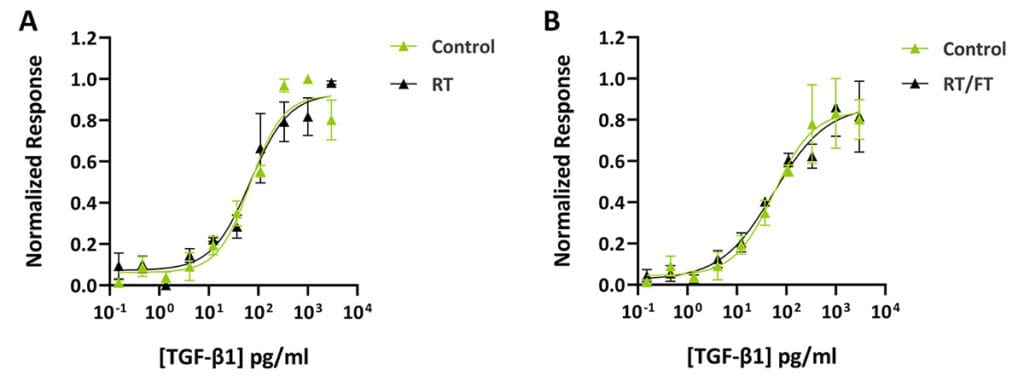
Figure 1. TGF-β1 PLUS™ bioactivity remained stable for 14 days. Bioactivity was determined using a TGF-β1-responsive (CAGA) firefly luciferase reporter in transiently transfected HEK293T cells. Cells were treated in triplicate for 6 hours with a serial dilution of TGF-β1 PLUS™ (Qk010). (A) Stored at room temperature (RT, EC50 66.20 pg/ml) or -80 °C (control, EC50 72.59 pg/ml). (B) Stored at room temperature with freeze thaws (RT/FT, EC50 53.27 pg/ml) or -80°C (control, EC50 57.29 pg/ml). Firefly luciferase activity was measured and normalized. Data from Qk010 lot #204762.
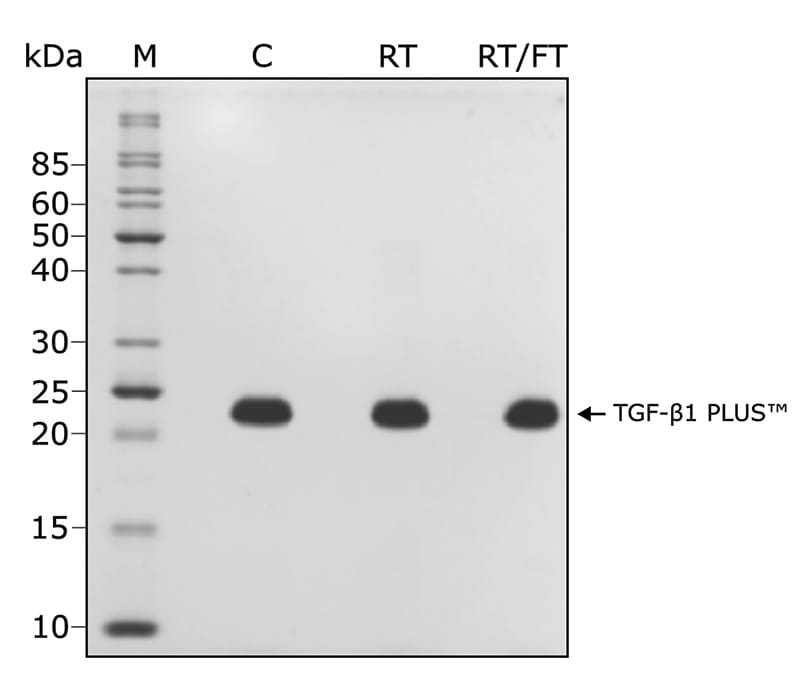
Figure 2. No degradation of TGF-β1 PLUS™ was visible after 14 days. Lyophilized protein was stored at room temperature (RT) or subjected to freeze-thaw cycles (RT/FT) for 14 days. 3 μg was resolved on a 15% w/v SDS-PAGE gel under non-reduced conditions and stained with Coomassie Brilliant Blue R250. Data from Qk010 lot #204762.
FGF-2 145 aa (Qk025)
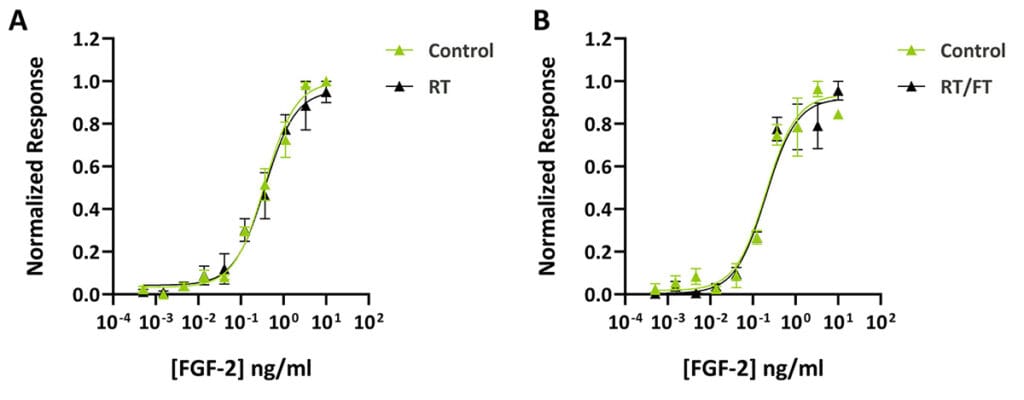
Figure 3. FGF-2 bioactivity remained stable for 14 days. Bioactivity was determined using a Promega serum response element luciferase reporter assay in transiently transfected HEK293T cells. Cells were treated in triplicate for 3 hours with a serial dilution of FGF-2 145 aa (Qk025). (A) Stored at room temperature (RT, EC50 0.35 ng/ml) or -80°C (control, EC50 0.38 ng/ml). (B) Stored at room temperature with freeze thaws (RT/FT, EC50 0.18 ng/ml) or -80 °C (control, EC50 0.23 ng/ml). Firefly luciferase activity was measured and normalized. Data from Qk025 lot #204706.
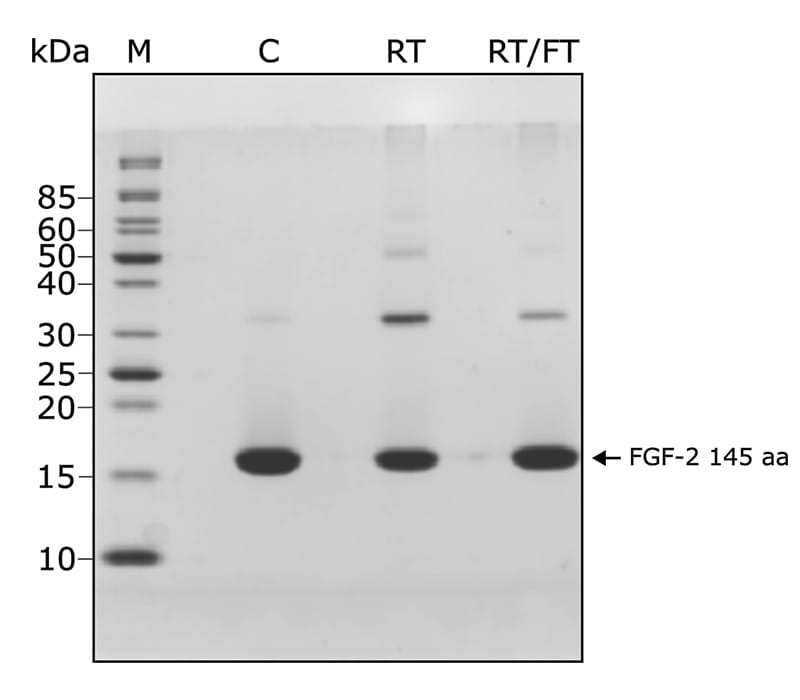
Figure 4. No degradation of FGF-2 was visible after 14 days. Lyophilized protein was stored at room temperature (RT) or subjected to freeze-thaw cycles (RT/FT) for 14 days. 3 μg was resolved on a 15% w/v SDS-PAGE gel under non-reduced conditions and stained with Coomassie Brilliant Blue R250. Data from Qk025 lot #204706.
Flt3L (Qk087)
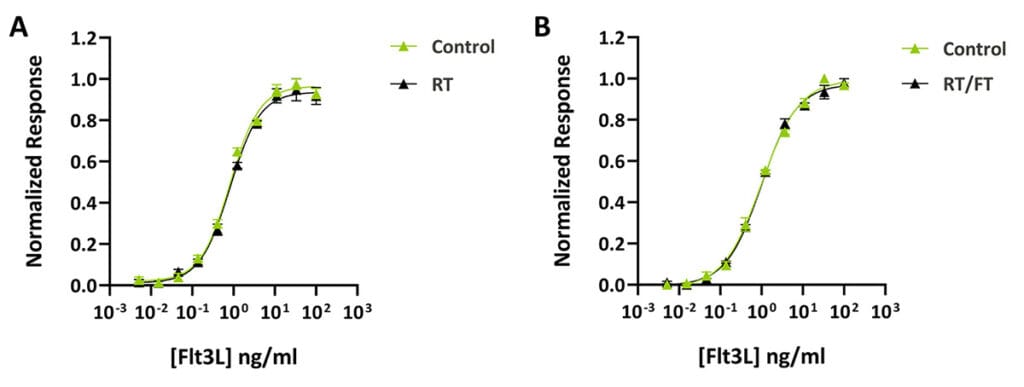
Figure 5. Flt3L bioactivity remained stable for 14 days. Bioactivity was determined using the proliferation of AML5 human myeloid leukemia cells. Cells were treated in triplicate with a serial dilution of Flt3L (Qk087) for 72 hours. (A) Stored at room temperature (RT, EC50 0.89 ng/ml) or -80°C (control, EC50 0.76 ng/ml). (B) Stored at room temperature with freeze thaws (RT/FT, EC50 0.96 ng/ml) or -80°C (control, EC50 1.04 ng/ml). Proliferation was measured using the CellTiter-Glo (Promega) assay. Data from Qk087 lot #204633.
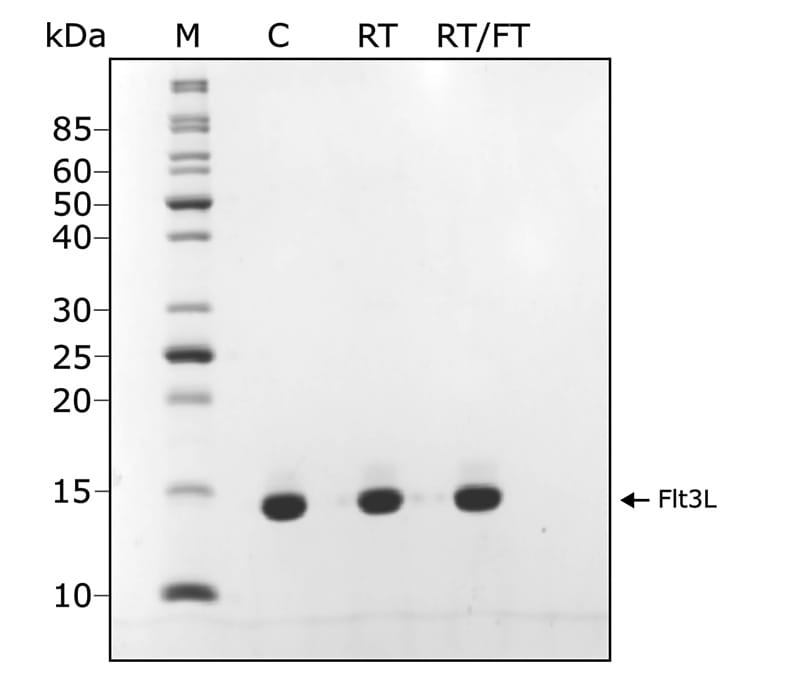
Figure 6. No degradation of Flt3L was visible after 14 days. Lyophilized protein was stored at room temperature (RT) or subjected to freeze-thaw cycles (RT/FT) for 14 days. 3 μg was resolved on a 15% w/v SDS-PAGE gel under non-reduced conditions and stained with Coomassie Brilliant Blue R250. Data from Qk087 lot #204633.
IL-2 (Qk089)
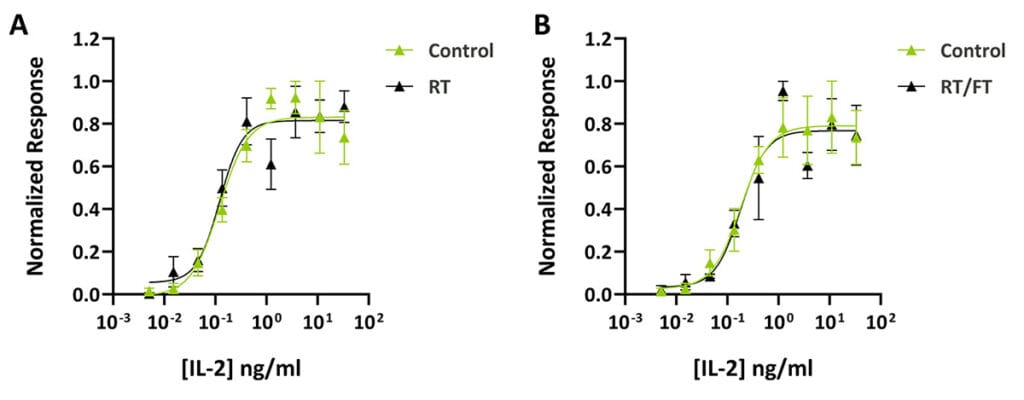
Figure 7. IL-2 bioactivity remained stable for 14 days. Bioactivity was determined using a SRE luciferase reporter assay in transiently transfected HEK293T cells co-transfected with the IL-2 receptors (IL-2Rβ and IL-2Rγ). Cells were treated in triplicate for 3 hours with a serial dilution of IL-2 (Qk089). (A) Stored at room temperature (RT, EC50 0.11 ng/ml) or -80 °C (control, EC50 0.14 ng/ml). (B) Stored at room temperature with freeze thaws (RT/FT, EC50 0.19 ng/ml) or -80 °C (control, EC50 0.18 ng/ml). Firefly luciferase activity was measured and normalized. Data from Qk089 lot #204781.
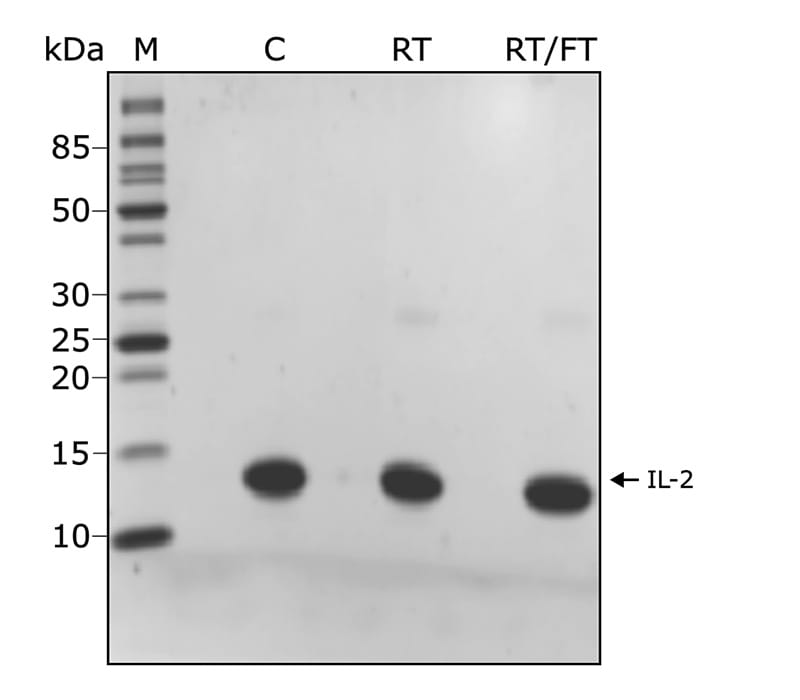
Figure 8. No degradation of IL-2 was visible after 14 days. Lyophilized protein was stored at room temperature (RT) or subjected to freeze-thaw cycles (RT/FT) for 14 days. 3 μg was resolved on a 15% w/v SDS-PAGE gel under non-reduced conditions and stained with Coomassie Brilliant Blue R250. Data from Qk089 lot #204781.
Conclusion
Qkine prides itself on the quality and bioactivity of its proteins. This testing demonstrated that there is no protein degradation or loss of activity over 14 days in lyophilized protein stored at room temperature with and without freeze-thaw cycles, indicating that there is no effect of fluctuating temperatures and delays that could be experienced during shipping.
Further information
Qkine growth factors are manufactured to the highest quality standards and are free from animal-derived contaminants, delivering low endotoxicity and high purity. At Qkine, we are committed to raising the standards of growth factors, cytokines, and related proteins to better support long-term and complex cell cultures. We are a science-led team, please reach out with any questions or requests to ryan.weber@matriqx.com.
- TGF-β1 PLUSTM (Qk010) – Qkine recombinant TGF-β1 PLUS™ protein is the first entirely animal origin-free recombinant human TGF-β1 protein for highly reproducible results and compatible with chemically-defined stem cell media. Also available as cell therapy grade with extended quality testing and documentation – Qk010-CTG
- FGF-2 145 aa (Qk025) – Our gold-standard and recommended FGF-2 protein for induced pluripotent stem cell (iPSC) and embryonic stem cell (ESC) maintenance, and iPSC and mesenchymal stem cell (MSC) proliferation and differentiation. Also available as cell therapy grade with extended quality testing and documentation – Qk025-CTG
- Flt3L (Qk087) – Qkine highly bioactive Flt3L is suitable for the culture of reproducible and high-quality myeloid progenitors and dendritic cells. Also available as cell therapy grade with extended quality testing and documentation – Qk087-CTG
- IL-2 (Qk089) – Qkine has optimized the IL-2 manufacture process to produce a highly bioactive protein with excellent lot-to-lot consistency for enhanced experimental reproducibility. Also available as cell therapy grade with extended quality testing and documentation – Qk089-CTG
All our recombinant proteins are animal-free and come with Bioactivity. Guaranteed.
Contact us
Our science team is here to help, please contact us if you have any questions.
