
 Recombinant human CNTF protein (Qk063)
 Price range: £190.00 through £2,090.00View product
Price range: £190.00 through £2,090.00
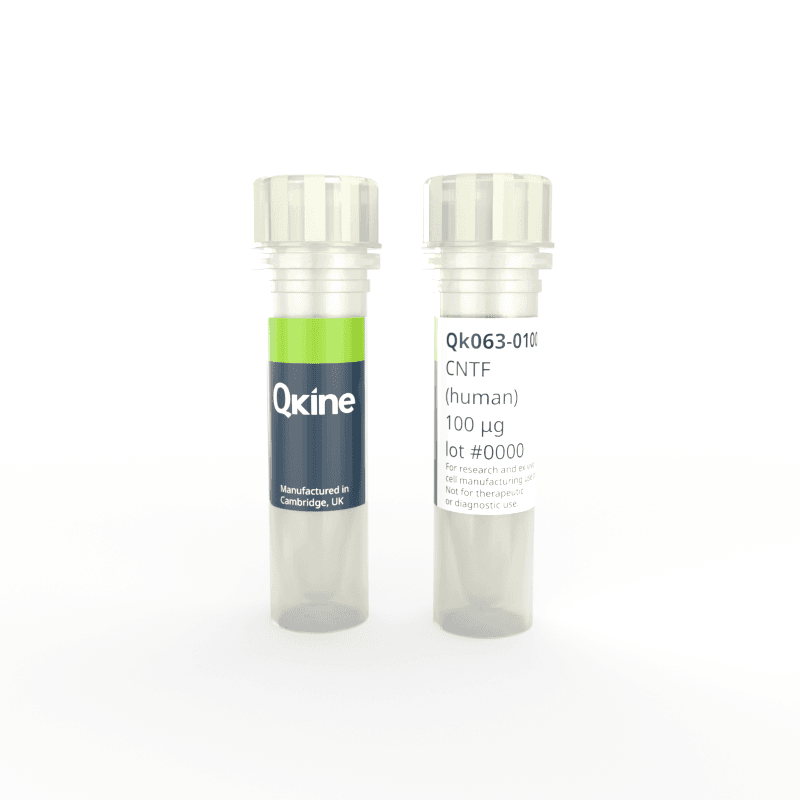
Ciliary Neurotrophic Factor (CNTF) is a member of the IL-6 family of cytokines. CNTF plays a crucial role in developing and maintaining the nervous system, in particular the optic nervous system. It promotes the maintenance, differentiation, and survival of various neurons, glial cells, and retinal cells. CNTF has been used in vitro to initiate neural induction and differentiation. CNTF can be used to culture primary neurons and glial cells such as astrocytes and Schwann cells. It is also used to culture retinal cells and adipocytes.
Human CNTF has a molecular weight of 22.8 kDa. This protein is animal origin-free, carrier-free, tag-free, and non-glycosylated to ensure its purity with exceptional lot-to-lot consistency. Qk063 is suitable for the culture of reproducible and high-quality neurons and other relevant cells.
This protein is also available as GMP compliant Cell Therapy Grade, to enquire email ryan.weber@matriqx.com.
In stock
Orders are typically shipped same or next day (except Friday).
Easy world-wide ordering, direct or through our distributors.
Price range: £190.00 through £2,090.00
Buy online with secure credit card or purchase order. For any questions, please email ryan.weber@matriqx.com
>98%, by SDS-PAGE quantitative densitometry
Expressed in E. coli
Animal origin-free (AOF) and carrier protein-free
Manufactured in our Cambridge, UK laboratories
Lyophilized from HEPES, NaCl
Neural stem cell proliferation and neuronal differentiation
Differentiation of iPSC derived neural progenitors to neurons
Differentiation of iPSC-derived Schwann cells and astrocytes
Culture of retinal cells
Induction of axonal growth
Neural stem cell research
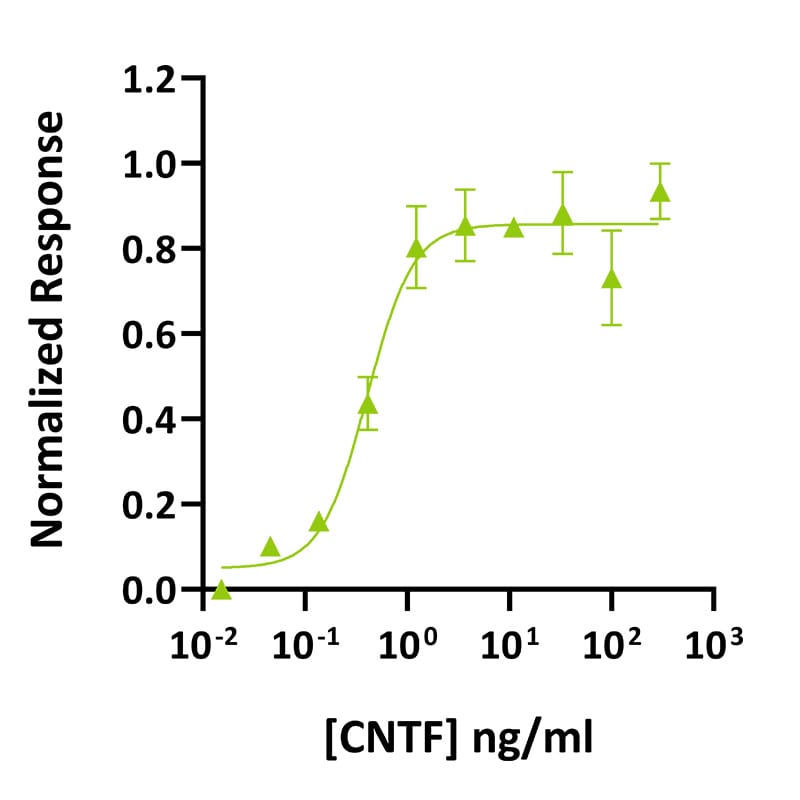
CNTF activity was determined using the CNTF-responsive firefly luciferase reporter assay. HEK293T cells were treated in triplicate with a serial dilution of CNTF overnight. Firefly luciferase activity was measured and normalised to the control Renilla luciferase activity. EC50 = 0.41 ng/ml (18 pM). Data from Qk063 lot #204526.
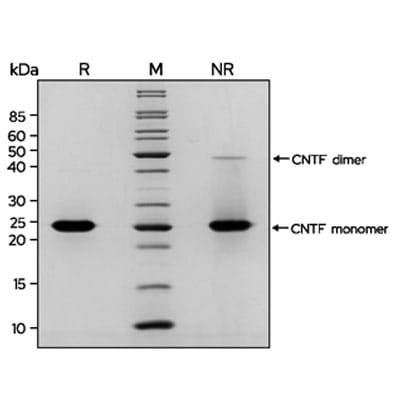
Recombinant CNTF migrates as a major band at approximately 22.8 kDa (monomer) in non-reducing (NR) conditions. The dimeric form is the minor band at the higher molecular weight (45.6 kDa). Upon reduction (R), only the 22.8 kDa band is visible. No contaminating protein bands are present. The purified recombinant protein (3 µg) was resolved using 15% w/v SDS-PAGE in reduced (+β-mercaptoethanol, R) and non-reduced (NR) conditions and stained with Coomassie Brilliant Blue R250. Data from Qk063 batch #204526.
Mass spectrometry: single species with expected mass
Recovery from stock vial: >95%
Endotoxin: <0.05 EU/μg protein
We are a company founded and run by scientists to provide a service and support innovation in stem cell biology and regenerative medicine. All our products are exceptionally high purity, with complete characterisation and bioactivity analysis on every lot.
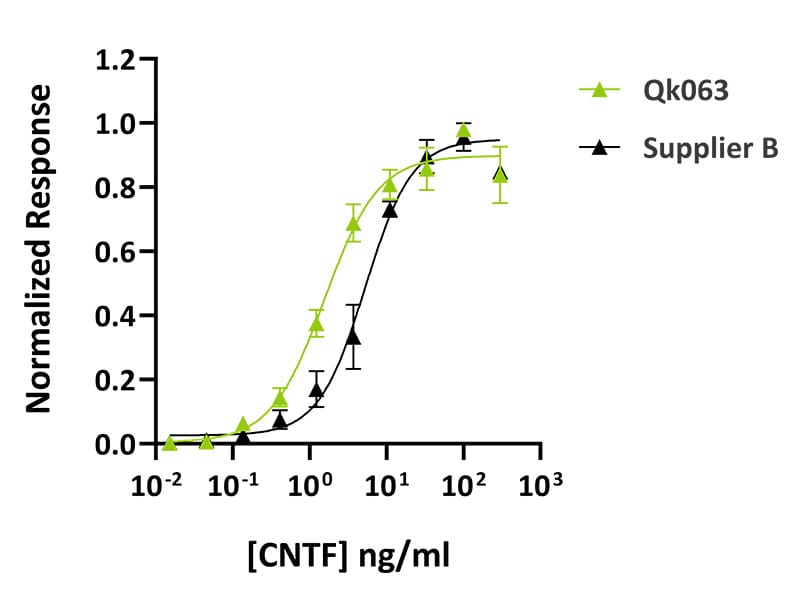
Qkine CNTF is more biologically active than a comparable alternative supplier protein. Bioactivity was determined using a CNTF-response luciferase reporter assay in HEK293T cells. Cells were treated in triplicate with a serial dilution of Qkine CNTF (Qk063, green) or Peprotech (450-13, Supplier B, black) for 24 hours. Firefly luciferase activity is measured and normalized to control Renilla luciferase activity.
Ciliary Neurotrophic Factor (CNTF) is a member of the IL-6 family of cytokines which also includes IL-6, IL-11, leukemia inhibitory factor (LIF), and Neuropoieitin [1-4]. It was initially isolated from chicken embryo ciliary neurons [4,5]. CNTF plays a crucial role in developing and maintaining the nervous and optic nervous systems [3,4,6,7]. It promotes the neurogenesis, differentiation, and survival of various neurons such as neural stem cells, sensory neurons, sympathetic neurons, and motor neurons, as well as oligodendrocytes, microglial cells, liver cells, skeletal muscle cells, and retinal cells [3,4,8–11]. Similarly, to LIF, CNTF is considered an inflammatory stimulation mediator with regenerative and axon growth-stimulating effects [12–14].
CNTF is a homodimer with a molecular weight of approximately 22.8 kDa and forms a four-helix bundle structure through hydrophobic interactions between the helices [2]. Each dimer is composed of 200 amino acids [2]. It is expressed by Schwann cells and astrocytes and binds to specific receptor complexes [2,3,15]. The complexes are composed of either the CNTF R alpha receptor subunit or the IL-6 R alpha receptor subunit with the recruitment of the gp130/LIFRβ receptor subunits [16]. This leads to the activation of various signaling pathways which promote cell survival, differentiation, and regeneration: JAK/STAT3 and PI3K/AKT/mTOR pathways [3,4,13,15].
As CNTF regulates neural development, it is used in vitro to initiate neural induction of human induced pluripotent stem cells (hiPSC) and differentiation of neural progenitor and neural stem cells along with IL-6, LIF, and oncostatin M [6,7,10]. CNTF promotes the self-renewal of neural stem cells with or without EGF, the survival of sensory and motor neurons, and neurite outgrowth [2,17,18]. CNTF also favours a cholinergic phenotype in sympathetic neurons [2,19–22]. Furthermore, CNTF can be used to promote the survival, differentiation, and maturation of glial cells such as astrocytes and Schwann cells. For example, Lin et al. showed that CNTF can activate microglia and dendritic-like microglia similarly to IL-6 [23]. Also, Krencik and Zhang describe how to differentiate hiPSC-derived neuroepithelial cells into astrocytes using E8 media supplemented with EGF, FGF-2, and CNTF [24]. Finally, Pan et al. used CNTF with neuregulin 1β and dibutyryl cyclic AMP to obtain Schwann cells [22]. In addition, CNTF has also been reported in the culture of retinal cells and adipocytes [11,25–27].
Due to its protective and regenerative role in the nervous system, research on CNTF has been focused on neurodegenerative diseases (amyotrophic lateral sclerosis, Parkinson’s disease, and Alzheimer’s disease) to slow down the disease progression, as well as retinal diseases (retinitis pigmentosa, and macular degeneration) [4,28–30]. CNTF has also been investigated to treat peripheral nerve injuries and chronic inflammatory diseases (multiple sclerosis) to enhance nerve regeneration and promote neurite growth [29]. The therapeutic potential of CNTF is also extended to treat metabolic diseases to regulate the balance of energy metabolism and induce body weight loss [3,4]. Finally, CNTF has been shown to be involved as a negative modulator of invasion processes of prostate cancer in an in vitro model [31].
Ciliary neurotrophic factor (CNTF) is an IL-6 family cytokine. It plays a crucial role in regulating the development of the nervous system and is involved in the differentiation and maintenance of various neurons, glial cells, and retinal cells.
CNTF expression is primarily found in neuronal cells, the eye and bone.
Yes, CNTF is a cytokine in the IL-6 family.
The CNTF gene codes for ciliary neurotrophic factor (CNTF) protein.
CNTF binds to a receptor complex made up of CNTF α-receptor (CNTFRα), the β-receptor glycoprotein 130 (GP130) and leukemia inhibitor factor receptor (LIFR).
CNTF receptor activation leads to the activation of multiple signaling pathways such as Ras/MAPK which regulate cell survival and proliferation.
CNTF activates cell survival-related signaling pathways including the ERK1/2, Ras/MAPK which stimulate transcription of cell survival and proliferation genes.
CNTF is used in the culture of neuronal and glial cells including primary neurons, astrocytes, Schwann cells, and retinal cells.
Our products are for research use only and not for diagnostic or therapeutic use. Products are not for resale.
For use in manufacturing of cellular or gene therapy products. Not intended for in vivo applications.

£100, $140 or €120 Qkine gift card for product reviews with an image and £50, $70 or €60 for reviews without an image.
 Recombinant human CNTF protein (Qk063)