
 StemBeads® Qkine GDNF DISC™ device
£70.00
£70.00
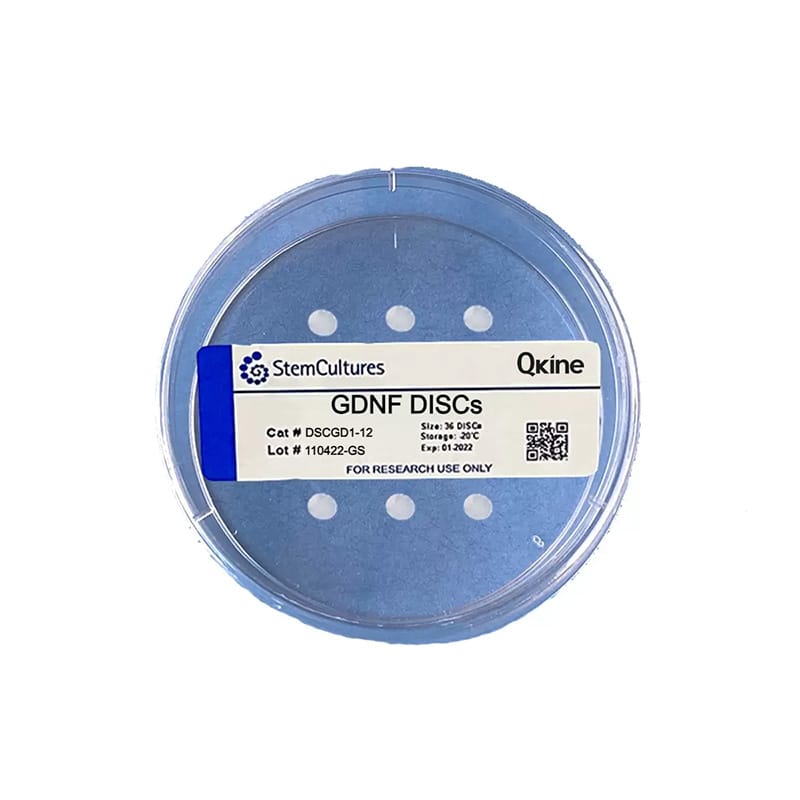


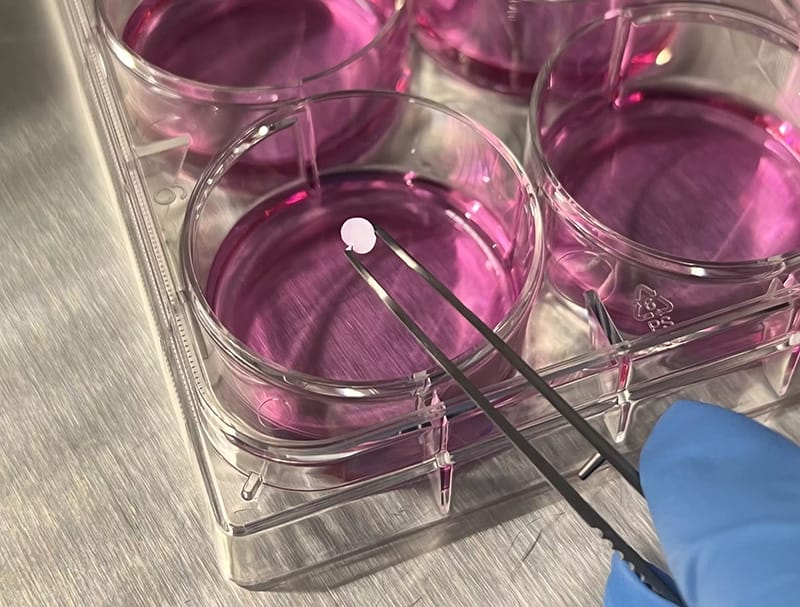
StemBeads® Qkine GDNF DISC™ devices are biocompatible and non-degradable hydrogels that contain GDNF StemBeads®. Combining StemBeads® Qkine GDNF, a patented growth factor supplement that offers a novel way to culture cells with native GDNF more efficiently, DISC devices are easy to add and remove, giving scientists enhanced control of growth factor levels in their stem cell and organoid cultures. GDNF is key for neural stem cell growth and differentiation. GDNF DISC™ devices have been tested in multiple neuronal base media, including Brain Phys, with enhanced cellular profiles. In these cases, GDNF DISC™ devices were used with and without BDNF DISC™ devices.
StemCultures StemBeads® revolutionary controlled-release protein technology combined with Qkine high purity and bioactivity animal origin-free growth factors and cytokines stabilizes growth factor levels for increased cell culture consistency and reproducibility.
More information and instructional video.
Shipping times may vary for this product, contact us for current lead times – ryan.weber@matriqx.com
In stock
Orders are typically shipped same or next day (except Friday).
Easy world-wide ordering, direct or through our distributors.
£70.00
Buy online with secure credit card or purchase order. For any questions, please email ryan.weber@matriqx.com
Micro-encapsulated high purity protein
StemBeads® technology for controlled-release
Lot-to-lot consistency in bioactivity
Neural differentiation from pluripotent stem cells
Differentiation of midbrain dopaminergic neurons

We are a company founded and run by scientists to provide a service and support innovation in stem cell biology and regenerative medicine. All our products are exceptionally high purity, with complete characterisation and bioactivity analysis on every lot.
GDNF DISC™ devices are patented inert, non-degradable, biocompatible hydrogels that release defined levels of native GDNF stably into culture medium over two weeks. GDNF DISC™ devices are loaded with StemBeads® Qkine GDNF, PLGA microbeads that encapsulate the protein. GDNF DISC™ devices are easy to add and remove, giving scientists enhanced control of growth factor levels in their cultures. Controlled delivery and stable levels overcome the 45 minute half-life of GDNF and improve cell cultures while saving researchers valuable time and resources.
GDNF DISC™ devices have been tested in multiple neuronal base media, including Brain Phys, with enhanced cellular profiles. In these cases, GDNF DISC™ devices were used with and without BDNF DISC™ devices.
We recommend a release of 5 ng/ml when culturing neuronal cells. However, to fit other needs, the release can be adjusted slightly based on the amount of medium and the number of DISCs that are added. See the table below for reference.
| Number of DISCs™
Per Well |
Volume of Medium Per Well | Sustained GDNF Release |
|---|---|---|
| 1 | 2 ml | 5 ng/ml |
| 1 | 1 ml | 10 ng/ml |
| 1 | 0.5 ml | 20 ng/ml |
| 2 | 2 ml | 10 ng/ml |
| 3 | 2 ml | 15 ng/ml |
| 4 | 2 ml | 20 ng/ml |
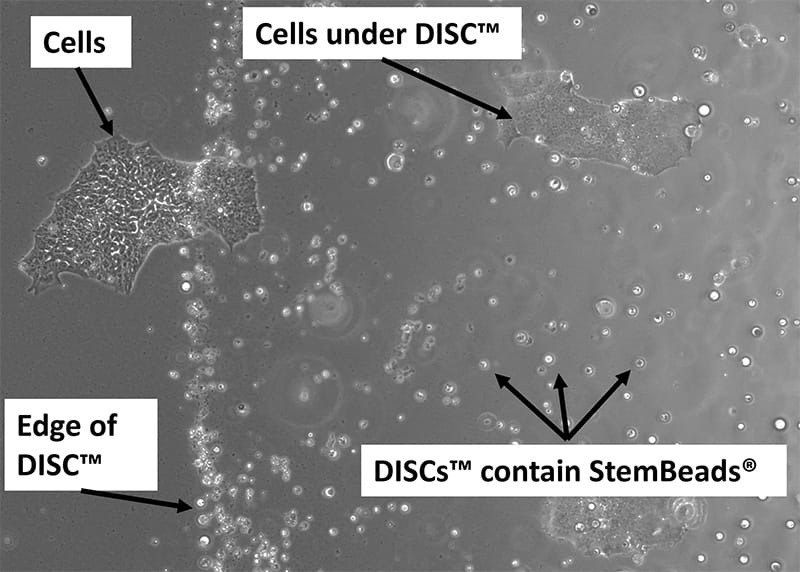
DISC™ device technology allows you to use your favorite media and feed less often. One DISC™ can remain in the culture well/vessel for several media feeds (i.e., a pack of 12 DISC™ devices will last 4 weeks when culturing in a 6 well plate). When added into media, DISC™ devices are designed to release at a constant 5 ng/ml. As DISCs™ rehydrate, they will swell and become transparent. Embedded StemBeads® will be visible under a microscope. This technology gives scientists enhanced control over growth factor levels in their cultures to provide robust, high-quality cells.
Glial cell line-derived neurotrophic factor (GDNF) is a neurotrophic factor and a member of the GDNF family of ligands (GFL) which include neurturin, artemin, and persephin [1,2]. GFLs regulate several biological processes including cell survival, cell proliferation, cell differentiation, cell migration, and neurite outgrowth [1,3,4]. GDNF protein plays a crucial role in the development, growth, and survival of neurons in particular midbrain dopaminergic neurons [5]. It promotes the axon growth and innervation of dopamine neurons. It also facilitates the differentiation of neural progenitors to astrocytes and is involved in neuroprotection[6,7]. In addition, it is involved in kidney development and spermatogenesis [8,9].
In cell culture, GDNF supports the survival and growth of neurons and astrocytes. It is used in combination with other growth factors to differentiate human induced pluripotent stem cell-derived neural progenitors into neurons and astrocytes. GDNF is used for the differentiation, survival, and maturation of dopaminergic neurons with brain-derived neurotrophic factor (BDNF), FGF-8a/FGF-8b, and Shh [10-13]. Glutamatergic and GABAergic neurons are obtained with combinations of BDNF, GDNF, NT-3, or insulin-like growth factor 1 (IGF-1) [14-16]. Also, the culture of cortical organoids requires BDNF and GDNF for maturation [17,18]. Finally, it can be used to generate and maintain astrocytes along with ciliary neurotrophic factor (CNTF) and leukemia inhibitory factor (LIF) [19-21].
GDNF DISC™ devices can be used with the media you normally use for your neuronal cell cultures. The only change is that when using DISC™ devices you don’t have to add soluble GDNF to the medium. Using DISC™ devices may also allow you to reduce the number of feeds. Sustained release of GDNF from DISC™ devices improves neuron culture quality over the use of soluble GDNF, which has a half-life less than an hour in cultures. This means you can use a lower level of growth factor when using DISC™ devices compared to soluble. You can also use BDNF and GDNF DISC™ devices together as your protocol requires.
GDNF DISC™ devices have been shown to have a positive impact on downstream applications. They increase MAP2A-positive axonal projections, enhance dendritic arborization, and increase Synapsin1 co-localization in MAP2A-positive cortical neurons.
We recommend changing the GDNF DISC™ device every 10-14 days.
No, leave the same DISC™ device in the well for about two weeks and perform medium changes without changing the DISC™ device. For tips and an instructional video on using and removing DISC™ devices, click this link: https://stemcultures.com/discs/
No, DISC™ devices can be easily added using sterile forceps and removed by using a low vacuum or pipette.
Standard size DISC™ devices are approximately 2-3 mm in diameter when dry, 5-6 mm in diameter when rehydrated.
The protein concentration can be adjusted based on the number of DISC™ devices added and the medium volume.
We recommend a release of 5 ng/ml when culturing neuronal cells. However, to fit other needs, the release can be adjusted slightly based on the amount of medium and the number of DISC™ devices that are added. See the table below for reference.
| Number of DISCs™
Per Well |
Volume of Medium Per Well | Sustained GDNF Release |
|---|---|---|
| 1 | 2 ml | 5 ng/ml |
| 1 | 1 ml | 10 ng/ml |
| 1 | 0.5 ml | 20 ng/ml |
| 2 | 2 ml | 10 ng/ml |
| 3 | 2 ml | 15 ng/ml |
| 4 | 2 ml | 20 ng/ml |
Yes, DISC™ hydrogels are inert and can be added to organoid cultures to supply growth factor for 2 weeks. This enables organoids to be grown efficiently.
When medium is changed less often, it should be expected that cell debris will accumulate and may appear at a higher level than when medium is changed daily. Users have not reported this as being detrimental.
For these types of cultures, we recommend adding the DISC™ device in a Transwell®. The DISC™ device will provide approximately the same sustained-release level throughout the Transwell® membrane. For example, for a culture of 1 ml, we recommend adding 750 μl of medium, then add 250 μl medium plus a DISC™ device into the Transwell®. The same DISC™ device plus Transwell® can be used for about 2 weeks.
DISCs are hydrogels and readily absorb moisture, which can cause them to stick and become more difficult to handle. We recommend storing DISC™ Devices at 4 °C in a moisture free environment. If DISC™ Devices do absorb moisture, e.g. if they were left out on a humid day, they should be re-dried by placing the packaging with the lid ajar for 15-30 minutes in a cell culture hood with the blower on.
Our products are for research use only and not for diagnostic or therapeutic use. Products are not for resale.
For use in manufacturing of cellular or gene therapy products. Not intended for in vivo applications.

£100, $140 or €120 Qkine gift card for product reviews with an image and £50, $70 or €60 for reviews without an image.
 StemBeads® Qkine GDNF DISC™ device