
 Recombinant human nodal protein (Qk029)
 Price range: £320.00 through £3,960.00View product
Price range: £320.00 through £3,960.00
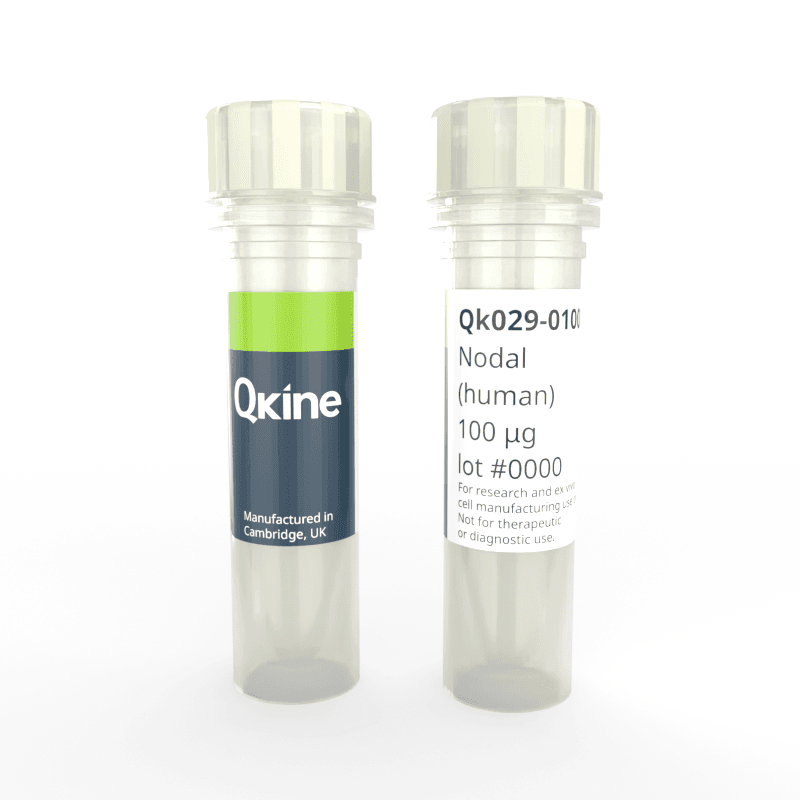
Nodal is a transforming growth factor β (TGF-β) family member which has an essential role in embryonic development. Nodal signaling controls endoderm and mesoderm germ layer specification whilst preventing neuroectoderm formation. It has also been implicated in cancer metastasis. Recombinant nodal has been found to maintain pluripotency in embryonic stem cells (hESCs) and induced pluripotent stem cells (iPSCs).
Qkine recombinant human nodal has been manufactured to be completely animal origin-free with reliable and consistent bioactivity for the reproducible maintenance of pluripotency in stem cells. Recombinant nodal is a 25.9 kDa homodimer, tag and carrier free.
This protein is also available as GMP compliant Cell Therapy Grade, to enquire email ryan.weber@matriqx.com.
In stock
Orders are typically shipped same or next day (except Friday).
Easy world-wide ordering, direct or through our distributors.
Price range: £320.00 through £3,960.00
Buy online with secure credit card or purchase order. For any questions, please email ryan.weber@matriqx.com
>98%, by SDS-PAGE quantitative densitometry
Animal origin-free (AOF) and carrier protein-free
Expressed in E. coli
Manufactured in our ISO 9001:2015 facility in Cambridge, UK
Lyophilized from acetonitrile, TFA
iPSC-derived mesoderm differentiation
Differentiation of iPSC into endoderm
Cancer research
Maintenance of pluripotency in iPSC
Maintenance of undifferentiated embryonic stem cells
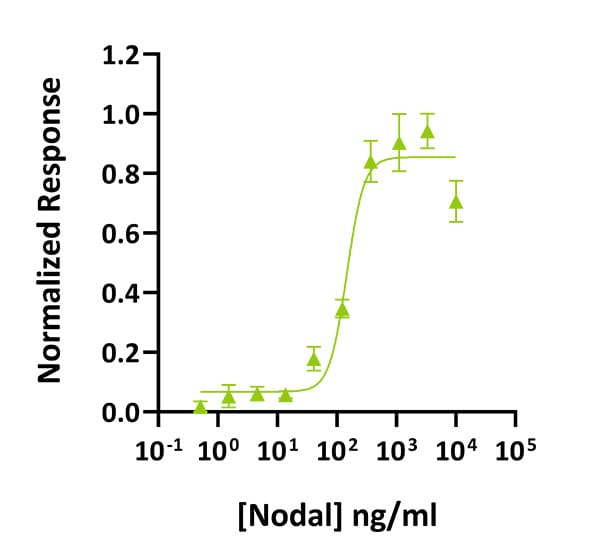
Recombinant nodal activity was determined using a P19 cell CAGA luciferase reporter assay. Transfected P19 cells were treated in triplicate with a serial dilution of Nodal for 6 hours. Firefly activity was measured and normalized to the control Renilla luciferase activity. Data from Qk029 lot 204811. EC50 = 147 ng/ml (5.68 nM).
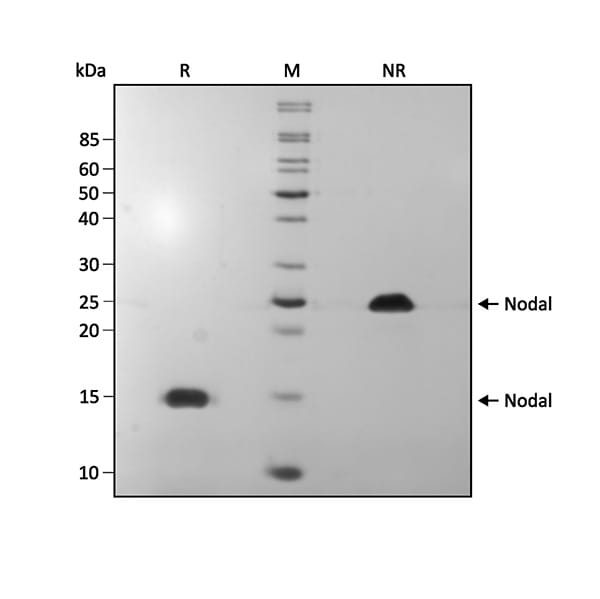
Recombinant nodal migrates as a major band at approximately 14 kDa (monomer) in reduced (R) and approximately 25 kDa (dimer) in non-reduced (NR) conditions. No contaminating protein bands are present. The purified recombinant protein (3 µg) was resolved using 15% w/v SDS-PAGE in reduced (+β-mercaptoethanol, R) and non-reduced (NR) conditions and stained with Coomassie Brilliant Blue R250. Data from Qk029 lot #204811.
Mass spectrometry: single species with expected mass
Recovery from stock vial: >95%
Endotoxin: <0.05 EU/μg protein
We are a company founded and run by scientists to provide a service and support innovation in stem cell biology and regenerative medicine. All our products are exceptionally high purity, with complete characterisation and bioactivity analysis on every lot.
Nodal is a member of the transforming growth factor β (TGF-β) family of proteins which regulate cell fate both during development and in adult tissues. The TGF-β family has three main subgroups, activin and inhibins, BMPs, and nodal proteins. Nodal is particularly known for its role in embryonic development and mesoderm formation [1, 2]. Nodal signalling is essential at the early epiblast stage and functions to maintain the expression of key pluripotency factors, along with BMPs nodal controls endoderm and mesoderm germ layer specification whilst blocking neuroectoderm formation [2].
Nodal is synthesized as a large precursor which is cleaved to produce the mature protein, which then functions as a disulfide linked homodimer [2]. TGF-β ligands signal through two receptors, type I and type II transmembrane serine-threonine kinases to activate downstream signaling through Smads. Studies have determined that BMP signaling uses Smad1, Smad5, and Smad8, whereas TGF-β, activin and nodal signaling is through Smad2 and Smad3 [1, 2, 5].
Expression of nodal, along with TGF-β1 and activin A, have been shown to maintain pluripotency of human embryonic stem cells (hESCs) in response to mechanical strain [3]. Recombinant nodal has been shown to increase matrix metalloprotease 2 (MMP-2) secretion and subsequent cell invasion in cancer models such as glioma [3]. Studies of gastruloids (embryonic organoids) have demonstrated a role of nodal expression in axial patterning, along with other factors such as FGF-2, DKK-1, BMP-4, and Wnt signaling [4]. In hESCs, recombinant nodal was found to maintain pluripotency and prevent default neuroectodermal differentiation in culture [2, 5].
Nodal is member of the transforming growth factor β (TGF-β) family of proteins, it has an essential role during embryonic development controlling body patterning.
Nodal is expressed primarily in the node, primitive streak, and left lateral plate mesoderm during embryonic development. It is also widely expressed in adult tissue and often over expressed in cancer.
Yes, nodal is classed as a cytokine.
The nodal gene, NODAL codes for the nodal pre-cursor, which contains a large pro-domain which is cleaved to produce a mature nodal protein.
Nodal bind to type II Activin receptors (ActRII/IIB), leading to the recruitment, phosphorylation and activation of type I Activin receptors (Activin receptor-like kinases, or ALKs, including ALK1-7).
Once activated the nodal receptor recruits and phosphorylates type I Activin receptors (Activin receptor-like kinases, or ALKs, including ALK1-7).
Nodal signals through Smads 2 and 3. Smad proteins can also associate with various tissue-specific transcription factors, which mediate a range of processes, including pluripotency.
Nodal can used to maintain pluripotency in embryonic stem cells (hESCs) and prevent neuroectoderm differentiation.
TGF beta family proteins and other growth factors can be very poorly soluble in physiological solutions. Please follow the handling guidance for lyophilized cytokines below to minimize loss of protein due to precipitation or adsorption to plastic. We advise storing the recombinant protein at very low pH before dilution in cell culture media or final working solutions. Low pH will also assist in maintaining the correct disulfide structure of the protein by minimizing disulfide bond exchange reactions.
Every effort is made to ensure samples are sterile; however, we recommend sterile filtering after dilution in media or the final working solution.
Our products are for research use only and not for diagnostic or therapeutic use. Products are not for resale.
For use in manufacturing of cellular or gene therapy products. Not intended for in vivo applications.

£100, $140 or €120 Qkine gift card for product reviews with an image and £50, $70 or €60 for reviews without an image.
 Recombinant human nodal protein (Qk029)