Why are Qkine’s new products labelled cell therapy grade and not GMP grade? image
Blog

Why are Qkine’s new products labelled cell therapy grade and not GMP grade?

Why are the products labelled cell therapy grade and not GMP grade? Although GMP-grade is a recognized term within the growth factor space, it is not an accreditation that can be strictly applied to products outside of the pharmaceutical, cosmetic or food industries. 
Unexpected consequences: growth factor cross-contamination in mammalian and E. coli expressed growth factors image
Blog

Animal origin-free protein manufacture for cell therapy

Qkine cell therapy grade proteins are animal origin-free, but why is this so important? The FDA are clear in their recommendation that animal origin-free reagents are used for increased safety in cell and gene therapy manufacture.
Adriana image
Blog

Adriana

Meet Adriana, Senior Lab Technician at Qkine, where precision meets passion. From protein purification to keeping the lab spotless, Adriana does it all. In this Q&A, she shares what life is really like in biotech, from late-night snack temptations to big career challenges, and leaves us with advice for the next generation of scientists.
Why animal origin-free? image
Blog

Why animal origin-free?

All Qkine proteins are animal origin-free, but why is this so important? Why aren’t all recombinant proteins produced in animal free expression systems? Read our latest blog and discover - Why animal origin-free?
Unexpected consequences: growth factor cross-contamination in mammalian and E. coli expressed growth factors image
Blog

Unexpected consequences: growth factor cross-contamination in mammalian and E. coli expressed growth factors

At Qkine we have repeatedly highlighted the need for stricter process and quality control in the manufacture of high purity in recombinant growth factors to prevent cross contamination with related growth factors. Contamination with other bioactive proteins leads to lack of inter and intra-lab reproducibility, or perhaps most concerningly incorrect scientific conclusions.
Qkine featured in the Nikkei Biotechnology & Business magazine image
Blog

My first cell ag conference: Waking up to the issues of meat

After attending her first alternative protein and cellular agriculture conference, the Bezos Centre for Sustainable Protein scientific kick-off, Liz describes what she learned about the need for alternative proteins and securing a sustainable future food source.
Protein tags, why and why not? image
Blog

Protein tags, why and why not?

Protein tags are useful tools for affinity purification and other biochemical applications, but unnecessary tagging of proteins can cause issues. Read our latest blog and discover - Protein tags, why and why not?
Qkine Product Launch Class of 2024 image
Blog

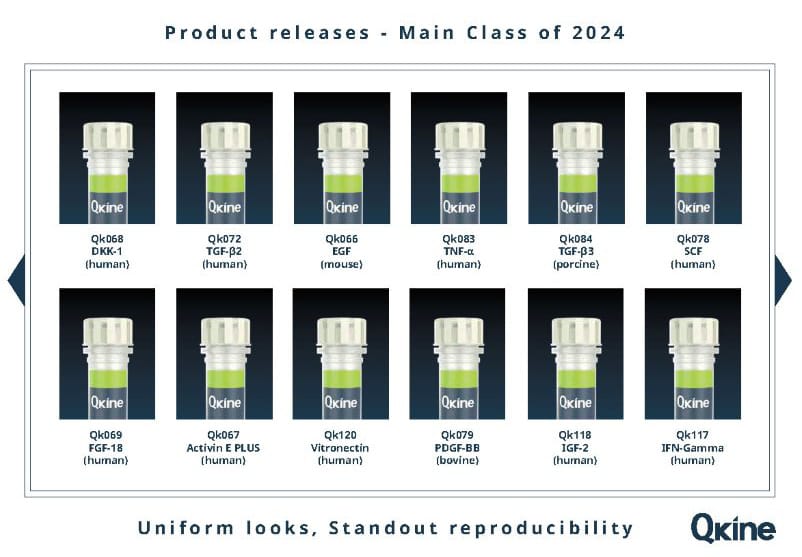
Qkine Product Launch Class of 2024

Class of 2024: celebrating the products launched in 2024 including expanding our hematopoietic range and adding tuna, salmon and eel FGF-2!
Leighton shares his journey at Qkine image
Blog

Leighton shares his journey at Qkine

In our latest career blog our Senior Cell Scientist Leighton shares his experience and journey at Qkine.
CARMA logo
Blog

CARMA panel discussion: How can we best transform academic innovation into scalable industrial processes? Part 3

This blog focuses academic-industrial relationships, what academic laboratories can learn from industrial experts. Read the other blogs for more insights.
CARMA logo
Blog

CARMA panel discussion: How can we best transform academic innovation into scalable industrial processes? Part 2

This blog focuses Importance of cell and growth factor selection and how this can affect the future regulatory approval and future commercialization of academic research. Read the other blogs for more insights.
CARMA logo
Blog

CARMA panel discussion: How can we best transform academic innovation into scalable industrial processes? Part 1

The panel discussion offered perspectives from companies working to bring cultivated meat, fish, fat and dairy to consumers. The aim was to inspire early career researchers and demystify research in this industry to highlight and encourage transitions in both directions between academia and industry. This blog focuses on the current regulatory frameworks and how the future of regulation may impact both industry and the future commercialization of academic research. Read the follow up blogs for more insights.
Shopping Basket