
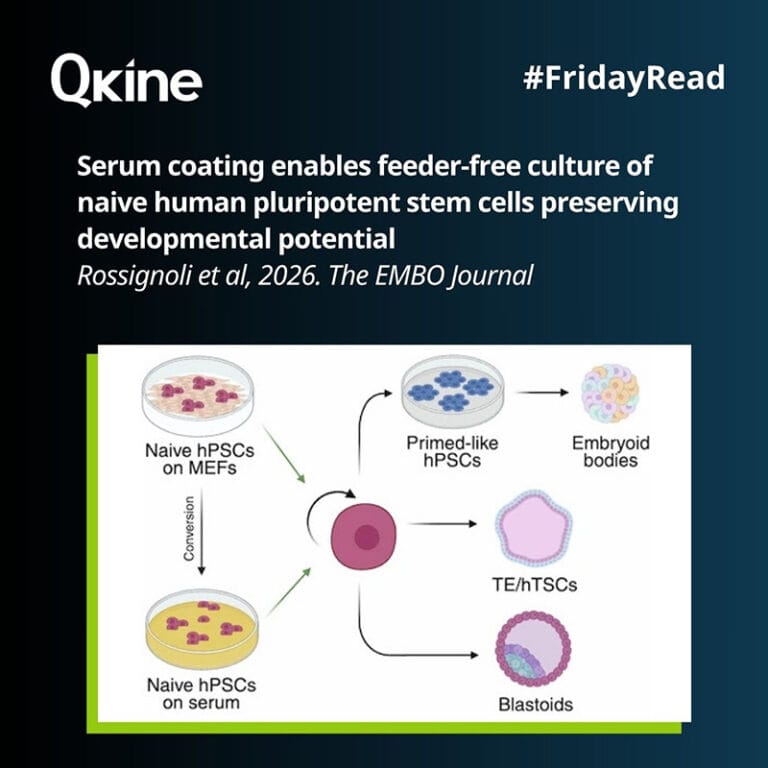
Serum coating enables feeder-free culture of naive human pluripotent stem cells preserving developmental potential
Rossignoli G, Oberhuemer M, Brun IS et al. The EMBO Journal, 2026.
This week’s #Fridayread describes a feeder cell-free culture system based on serum coating that supports long-term maintenance of naive human pluripotent stem cells (hPSCs).
Naive hPSC represent a preimplantation epiblast state able to efficiently differentiate into embryonic and extraembryonic pre-implantation lineages. Their maintenance routinely relies on co-culture with mouse embryonic fibroblast (MEFs) as feeder cells, a method prone to variability.
In a collaborative effort, five independent laboratories tested thirty serum batches for the culture of eight naïve hPSCs lines. Cells cultured on serum coating displayed growth kinetics, clonogenic capacity, mutation rates, and global gene expression profiles comparable to MEF-based cultures. Naive hPSCs efficiently underwent germ layer specification, retained trophectoderm competence, and generated blastoids with efficiency similar to MEF-based cultures.
This study showed that serum coating provides a scalable, cost-effective, and robust alternative to feeder-based systems, facilitating larger-scale applications of naive hPSCs and enabling more reproducible mechanistic studies.
This study used Qkine animal origin-free proteins:
