
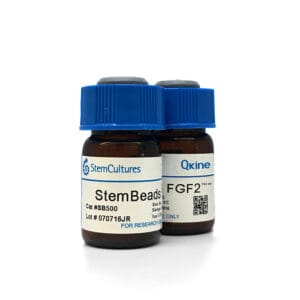
 StemBeads® Qkine FGF-2 154 aa
 Price range: £95.00 through £215.00View product
Price range: £95.00 through £215.00


StemBeads® Qkine FGF-2 154 aa is a patented growth factor supplement that offers a novel way to culture cells with native fibroblast growth factor 2 more efficiently. FGF-2 is key for growth of human induced pluripotent stem cells (iPSCs), fibroblast cells, wound healing cells such as macrophages, cancer cells, and neural progenitor cells (NPCs).
StemBeads® revolutionary controlled-release protein technology combined with Qkine high purity and bioactivity animal origin-free growth factors and cytokines stabilizes growth factor levels for increased cell culture consistency and reproducibility.
In stock
Orders are typically shipped same or next day (except Friday).
Easy world-wide ordering, direct or through our distributors.
Price range: £95.00 through £215.00
Buy online with secure credit card or purchase order. For any questions, please email ryan.weber@matriqx.com
Micro-encapsulated high purity protein
StemBeads® technology for controlled-release
Lot-to-lot consistency in bioactivity
Expansion of induced pluripotent, embryonic and mesenchymal stem cells

We are a company founded and run by scientists to provide a service and support innovation in stem cell biology and regenerative medicine. All our products are exceptionally high purity, with complete characterisation and bioactivity analysis on every lot.
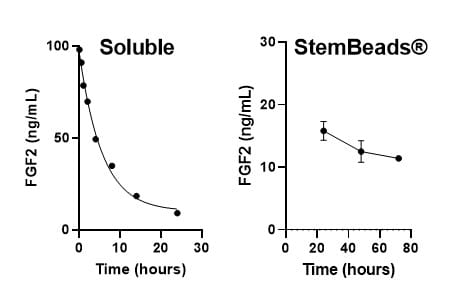
StemBeads® Qkine FGF-2 154 aa is a patented growth factor supplement that offers a novel way to culture cells with native Fibroblast Growth Factor 2 more efficiently. FGF-2 is key for growth of human induced pluripotent stem cells (iPSCs), fibroblast cells, wound healing cells such as macrophages, cancer cells, and neural progenitor cells (NPCs). StemBeads® Qkine FGF2 154 aa are microbeads composed of an FDA approved, biodegradable PLGA polymer that is loaded with Qkine recombinant human FG-F2 154 aa (Qk027, Highly pure and bioactive 17 kDa FGF-2 protein animal origin-free (AOF) and carrier protein-free (CF)). Controlled delivery and stable levels overcome the 4.5 hour half-life (Figure above) of FGF-2 and improve cell cultures while saving researchers valuable time and resources.
StemBeads® Qkine FGF-2 154 aa have been tested in media such as mTeSR, mTeSR plus, Stemflex, Flex 8, Nutristem, 10% FBS, and neuronal medium including neural progenitor expansion medium (NPEM) with enhanced cellular profiles. StemBeads® Qkine FGF2 154 aa can be combined with other StemBeads® varieties.
StemBeads are a revolutionary controlled-release growth factor technology. The StemBeads product is currently used for improved cell culture in more than 100 scientific laboratories globally. StemBeads technology encapsulates a growth factor in a PLGA hydrogel that stabilizes the protein and releases it steadily over several days. With growth factor levels stabilized, spontaneous differentiation is reduced, pluripotency is increased, and feeding schedules are reduced to only 2-3 times per week. StemBeads are added to your medium to achieve a desired growth factor release, sustained over several days. Following, the beads are washed from the culture, the medium is replaced, and the process repeated as required.
FGF-2 is an essential growth factor for the maintenance of pluripotency in human embryonic stem cells (ESCs), induced pluripotent stem cells (iPSCs) [1] and mesenchymal stem cells (MSCs) [2]. FGF-2 preserves pluripotency through interaction with PI3 kinase/Akt, ERK1/2, JAK/STAT and PLCγ pathways by activation of activin A. In feeder culture systems FGF-2 stimulates production of essential growth factors and cytokines from the feeder layer [2].
Lotz S, Goderie S, Tokas N et al.
DOI: DOI: 10.1371/journal.pone.0056289TCW J, Qian L, Pipalia NH et al.
DOI: DOI: 10.1016/j.cell.2022.05.017StemBeads® can be easily removed prior to analysis by washing 1-2 times with PBS, DMEM, F12 or any other basal medium preferred. For suspension cultures, there are a variety of strainer pore sizes to allow for separation. Cells cultured with StemBeads® have been used in a variety of downstream applications, including but not limited to: immunofluorescence, FACS, RNA/DNA extraction, nucleofection, differentiation etc.
The protein concentration can be adjusted based on the number of StemBeads® that you use. The release rate has a linear correlation with the amount of StemBeads® used. For example, 8 µl of StemBeads® per ml of media releases at a concentration of 10 ng/ml. However, if you desire half of that concentration, such as 5 ng/ml, then adjust the concentration to 4 µl of StemBeads® per ml media to achieve the concentration of 5 ng/ml.
With growth factor levels stabilized, spontaneous differentiation is reduced, pluripotency is increased, and feeding schedules are reduced to only 2-3 times per week. StemBeads are added to your medium to achieve a desired growth factor release, sustained over several days. Following, the beads are washed from the culture, the medium is replaced, and the process repeated as required.
No, this is not a problem or indication of cell quality. Extensive testing has been performed to access the cell quality when using StemBeads®. All phenotypic and functional assays have shown cell quality as good or better than current feeding regimens. For best assessment of cells, wash cells once prior to observation.
Fibroblast growth factor 2 (FGF-2), also known as basic fibroblast growth factor (bFGF) is a growth factor and signaling protein.
FGF-2 is expressed in a developmental and tissue specific manner. It’s expression is tightly controlled in normal tissues and it can be detected in all major tissues.
FGF-2 is essential for normal embryonic development. It has roles in cell survival and proliferation, angiogenesis, tumorigenesis, wound healing and tissue repair.
FGF-2 is used to maintain the pluripotency of stem cells in culture.
FGF-2 binds to and signals though all four of the FGF receptors FGFR1-4.
Our products are for research use only and not for diagnostic or therapeutic use. Products are not for resale.
For use in manufacturing of cellular or gene therapy products. Not intended for in vivo applications.

£100, $140 or €120 Qkine gift card for product reviews with an image and £50, $70 or €60 for reviews without an image.
 StemBeads® Qkine FGF-2 154 aa